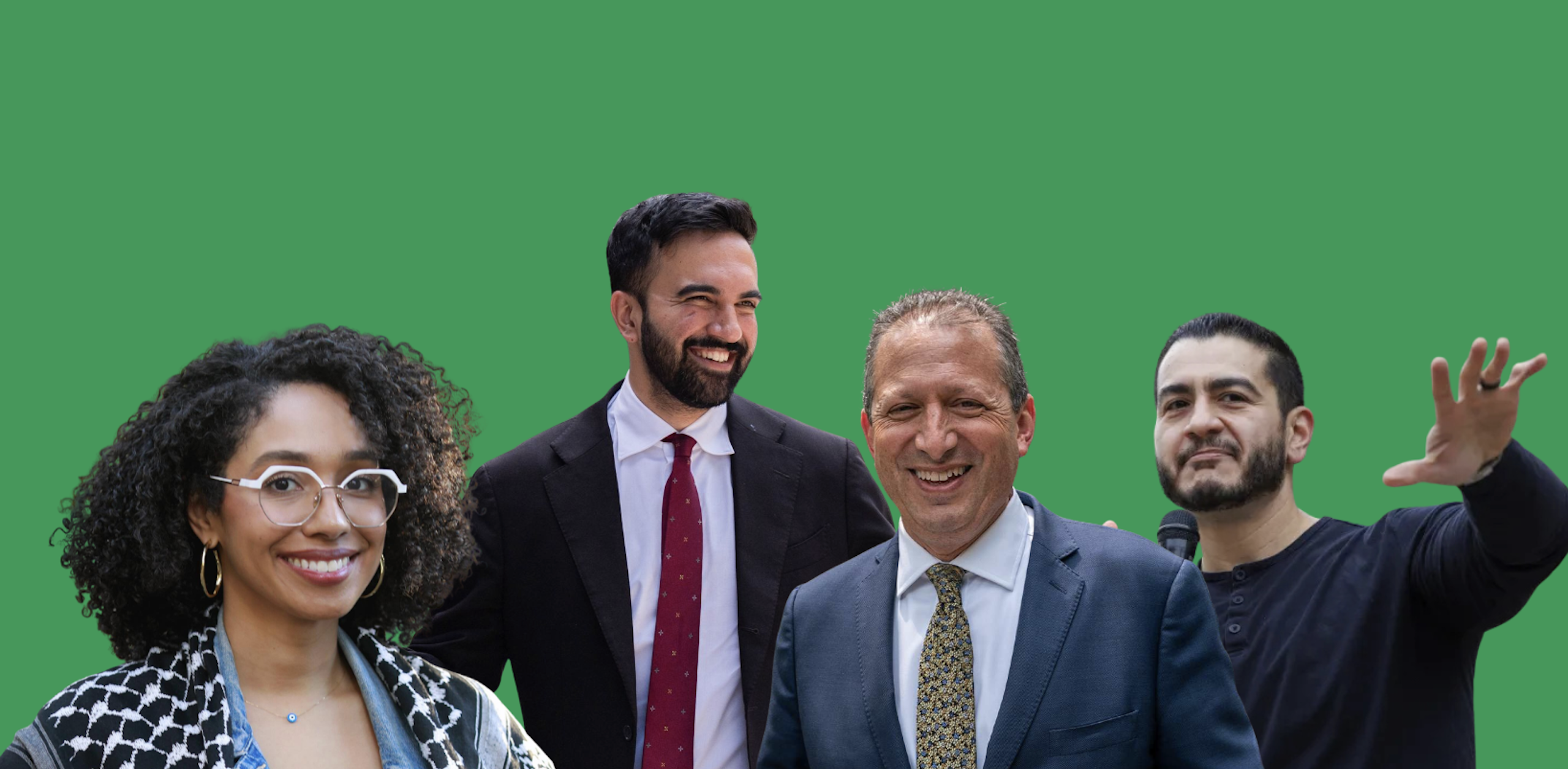
A little over a week ago, Brad Lander—fresh off his recent ousting of incumbent Dan Goldman as the Democratic Party candidate for New York’s 10th congressional district— endorsed Dr. Abdul El-Sayed for the upcoming August 4 primary to become the Democratic Party’s Senate candidate in Michigan.
This endorsement reveals something fascinating about anti-Zionism in American politics, something that has become even more pronounced with Wednesday’s historic vote in the House of Representatives, in which a majority of Democrats voted to withhold military aid to Israel.
What it shows, primarily, are two things:
One, that making a commitment to curb Israel’s ability to wage war is the new floor necessary to win elections in the United States.
And two, that coalitions around Israel have been scrambled and re-aligned. Not so long ago, a liberal Zionist might join forces with a zealot like Chuck Schumer in trying to defeat someone like El-Sayed. For a long time, such coalitions tended to pull tepid critics of Israel towards public support for the ethnostate. Things are a little different today. Americans now live in a world where liberal Zionists are no longer the outer, most Palestine-sympathetic edge of a coalition dominated by militant Zionist hawks. Rather, sympathy for Palestinians and anger at Israel have become defining aspects of Democratic coalition building. Politicians like Lander now occupy the outer edge of a coalition driven by El-Sayed and Mamdani. Instead of nudging people towards Zionism, such coalitions are pulling progressive politicians more towards the pro-Palestine camp with each special election.
Writing in the Nation, Nathan J. Robinson identified Dr. El-Sayed’s race against Congresswoman Haley Stevens—who is being backed, to the tune of tens of millions of dollars, by AIPAC and other pro-Israel groups—as the most important election in the country, with the power to shatter assumptions about electability in general and about Israel in particular “for good.” I agree. But I actually think the most figure who best illustrates how these coalitions have been reconfigured is not El-Sayed, but Lander.
To witness the evolution of Lander’s affiliations and relationships is to see the profound shift that has occurred inside the Democratic Party
This does not mean I think Lander is more important because he is white and Jewish. Lander has described himself as a liberal Zionist and is sometimes dismissed by anti-Zionists as “Blander” for his moderate position on Israel. Meanwhile, Dr. El-Sayed is a bombastically loud, full-throated critic of Israel. But to witness the evolution of Lander’s affiliations and relationships is to see the profound shift that has occurred inside the Democratic Party, and across American politics in general. It’s a shift that has reversed the trend of pro-Palestine candidates being pressured to support Israel in order to win office (which happened, for example, in the months between when Alexandria Occasio-Cortez won her primary in 2018 and her seat in 2018). Now, to win elections—and, especially in New York City, to actually succeed in government—soft supporters of Israel are being pressured to support Palestine and pulled into coalition with anti-Zionists.
A former member of the New York City Council and its most recent Comptroller, Lander has long been a known figure in Gotham politics, but he began to generate national attention during a single week in June just over a year ago. It was then that he and Zohran Mamdani cross-endorsed each other in New York’s ranked-choice mayoral primary in the hope of using what I called in these pages a politics of vulnerability to make sure Andrew Cuomo did not win. Lander then really made headlines when he was arrested by ICE agents while escorting (and trying to protect) a constituent in immigration court. At the time, I wrote that he was just one of a handful of American elected officials who were meeting the crisis of ICE kidnappings with the seriousness required.
I got to speak to Lander earlier this summer, in a brief, chance encounter on June 14. We ran into each other in Park Slope during Brooklyn Pride, on the first day of early voting. I was wearing a rainbow keffiyeh wrapped around my head and I thanked him for putting his body on the line for his constituents; I also told him about trying to protect my students as a professor when they were protesting for Palestinians. He asked about where I taught and told him about my story (which, as I wrote last week, has now resulted in me suing Northwestern University and several federal officials). He thanked me for what I’d done, and we had a very interesting conversation about our responsibilities (as a politician and as a teacher) to those we serve.
We also discussed visiting Palestine not so far apart (me in 2008, he in 2010) and talking to Palestinians now. I asked if I could take a picture with him (something I rarely do with politicians and probably would not have done if I had a “job”) and he eagerly agreed to do so. I did so in part because I wanted to post a Pride pol pic with my rainbow keffiyeh in the hopes it would pull Lander away from pinkwashing and ever-closer to the Palestinian cause.
Some friends chided me (which is fine) for posing with a liberal Zionist. But the thing is, I felt happy that after hearing what had happened to me at Northwestern, this possible Democratic Congressman from New York wanted to be photographed with me—and I felt confident that getting a visual record of Lander posing not with a queer in bland rainbow merch but with a keffiyeh-clad-homo would pull him closer to my politics, rather than pull me towards any version of Zionism. I also left that conversation knowing for certain something which I had long suspected: that Lander understands the connection between police violence, ICE violence, and US-Israel violence. In my fifteen years as a reporter, this has been a central political thread that ran through activist spaces, from Zuccotti Park to Ferguson to college campuses around the world.
Lander did not feel the need to appease the Zionist mob by softening his rhetoric.
It’s exciting to see that connection not being relegated to activist spaces, but made central to the political identity of electoral candidates. And this trend is not siloed in New York City; in Colorado, Palestine-supporting, DSA-backed Melat Kiros beat AIPAC-backed Congresswoman Diana DiGette (who’d been in office since before Miros was born!).
About a week after we met, Lander won the nomination and will, presumably, win the seat in November. It was an incredible day for the left and for supporters of Palestine: Mayor Zohran Mamdani had endorsed eight candidates for office, including Brian Romero and Eon Huntley for State Assembly, and Lander, Darializa Avila Chevalier, and Claire Valdez for congress. Most of the “Mamdani Slate” (or the “Hateful Eight,” as the New York Post absurdly labeled them) were also backed by the DSA and all were vocal critics of Israel.
Even though Lander was put on the defensive after he won, immediately accused of being a self-hating Jew who had abandoned Israel, the congressman-elect followed Bernie Sanders and AOC in endorsing El-Sayed.
In other words, Lander did not feel the need to appease the Zionist mob by softening his rhetoric. Instead, he doubled down on his coalition with people even more critical of Israel than him.
This shows us how the coalitions have changed. The Mamdani Slate included Lander and Chevalier, who attended a rally for Palestine just one day after the October 7 attacks (a rally AOC denounced) and whose political rise came out of attending the Gaza Solidarity Encampment at Columbia University. As I reported from that encampment, there were powerful seeds planted amongst the attendees there, and Chevalier’s election is just one example of the unexpected fruit which will grow from such spaces in the years and decades to come. It included the relatively mild and the full-throated, anti-imperialist and anti-Zionist voices alike. They all make the links between capitalism, policing, and foreign wars. How radical they are varies, but they have a new floor—and that floor includes restraining Israel, at the very least. It also includes support for trans people. (Interestingly, when I attended an emergency rally outside the Stonewall Inn last month, on an evening when the Supreme Court ruled against trans kids’ right to play sports in school, only two electeds showed up: Brian Romer and Brand Lander.)
When I was at the Columbia encampment, Norman Finkelstein addressed the students. He noted that for years there was a dominant political impulse driving discourse around Palestine and Israel: figure out a way to create a two-state solution based on 1967 borders. However, as Finkelstein correctly noted, since October 7 a much louder demand has challenged (if not taken over) the ‘67 discourse: revert to 1948 borders, because the entire Zionist project is, and always was, immoral and illegal. There now existed, he said, a significant tension between the ‘67 and ‘48 camps.
Now, I would argue that tension between the ‘67 and ‘48 camps is relatively low, particularly when compared to the chasm that exists between the ‘67 camp (who, in theory, support a mythical, impossible “two state solution”) and the seemingly insatiable bloodlust of current-day Zionists. When Brad Lander was questioned on CNN about what he’d have done after October 7, he answered that he would not have killed 5,000 Palestinian children. The ‘67 camp are being pulled towards the idea of Israel as a single, democratic state where everyone has equal rights, i.e. they are being pulled away from the concept of a Zionist state.
The power of this realignment exploded into public view last week, when House Minority Leader Hakeem Jeffries allowed a vote on the “Massie Amendment” to cut off military aid to Israel. The idea of Hakeem “Israel today, Israel tomorrow, Israel forever” Jeffries even allowing such a vote to come to the floor is almost impossible for me to believe (and I doubt he would have allowed it if he thought it would pass). Still, 103 of his 212 member coalition voted to defund Israel, revealing the true breadth of this new coalition. Even Kamala Harris is reaching out to Mamdani and key Palestine supporters, presumably because she now knows that her position on Palestine likely cost her the 2024 election.
This is one area where Mamdani has altered the American political landscape more than any elected official: he has created a new floor for Palestine advocacy.
In his college days, Zohran Mamdani started Bowdoin’s chapter of Students for Justice in Palestine. He was arrested with Jewish Voice for Peace activists outside Chuck Schumer’s home in 2023. But in the first six months or so in office, he has been noticeably less vocal about Palestine than he was as a student and candidate, and his commitment to Palestine has been understandably questioned—even as he called out the murder of Al Jazeera Journalist Ahmed Wishah and condemned the abduction of Dr. Hussam Abu Safiya at the Mandela Leadership Forum last week. But in recent days and, notably, in the politics of whom he chose to endorse for office this summer, Mamdani has been illustrating a keen and commanding use of his growing political capital to use his municipal power to affect U.S. foreign policy (including having New York City’s lawyers explore how to arrest Benjamin Netenyahu). Asked by the New York Times about Harris reaching out to people like him on Gaza as she mulls another presidential run, Mamdani answered, “one of the common features between all of the people that I endorsed for Congress was that each one of these candidates spoke about how they would sign on to the Block the Bombs legislation. It speaks about an unwillingness to continue to be complicit in a genocide. And we’re talking about billions of dollars in material support. So I think the first step for any presidential candidate looking to earn the trust of people across the country is a recognition of what our policy has wrought and what a different policy would deliver.”
This is one area where Mamdani has altered the American political landscape more than any elected official: he has created a new floor for Palestine advocacy. (This has resulted in AOC abandoning her absurd claim that funding Israel’s Iron Dome was merely facilitating “defense” and pushed her to vigorously vote against all military aid to Israel.)
As I wrote in my book The Overseer Class, politicians from minoritized communities are often elected to office with the expectation that they’ll pull the ladder up behind them and put a cap on how radical politics can be. But while Mamdani has, so far, been somewhat circumspect in his approach to Palestine as mayor, he has extended vital endorsements to candidates with even more radical stances on the issue than he—people like Darializa Avila Chevalier, Claire Valdez, Eon Huntley, and Brian Romero.
Criticizing Israel is the new floor for a winning Democratic coalition. Working within such a coalition, activists can now feel more emboldened to do the truly necessary work of helping liberate Palestine once and for all.