The Coral Coast Highway, considered one of the world’s greatest road trips, starts in Perth, Australia, and follows the coastline north to Exmouth. Halfway along this epic tour of red sand meeting azure water, there is a W-shaped set of bays, marking the westernmost point of Australia. Known as the Shark Bay UNESCO World Heritage Site, the place gets its name from English buccaneer-cum-naturalist William Dampier, who was overcome by the bay’s sheer abundance and the size of the marine predators during a visit in 1699.
Jalan Raya Pantai Koral, dianggap salah satu perjalanan darat terhebat di dunia, dimulai di Perth, Australia, dan mengikuti garis pantai ke utara menuju Exmouth. Separuh jalan dalam tur epik ini, di mana pasir merah bertemu air biru, terdapat serangkaian teluk berbentuk huruf W yang menandai titik barat paling ujung Australia. Dikenal sebagai Shark Bay UNESCO World Heritage Site, tempat ini mendapat nama dari bajak laut-turned-naturalis Inggris William Dampier, yang terpesona oleh kelimpahan teluk dan ukuran predator lautnya saat mengunjungi pada 1699.
In an early example of the “charismatic megafauna” effect, while Dampier was busy gawping at sharks, he unfortunately failed to notice that he was also surrounded by the oldest known life-forms on our planet, still hanging in there after 3.5 billion years. If you take a look at satellite imagery of the region, you’ll notice that the rightmost of the two bays is a richer emerald color than the other, having been long isolated from the ocean by sediment and seagrass, causing it to accumulate salt.
Dalam contoh awal efek “megafauna karismatik”, saat Dampier sibuk menatap hiu, ia sayangnya tidak menyadari bahwa ia juga dikelilingi oleh bentuk kehidupan tertua yang dikenal di planet kita, yang masih bertahan setelah 3,5 miliar tahun. Jika Anda melihat citra satelit wilayah ini, Anda akan memperhatikan bahwa teluk kanan dari dua teluk itu memiliki warna zamrud yang lebih kaya daripada yang lainnya, karena telah lama terpisah dari samudra oleh sedimen dan rumput laut, menyebabkan teluk tersebut mengakumulasi garam.
At the southern point of this pool of hypersaline water, you will find Hamelin Pool, where hundreds of dome-shaped chunks of rock emerge from the shallow water like gargantuan rabbit droppings. These rocks, known as “stromatolites,” might not look particularly interesting compared to the sharks, but they are in fact ancient survivors and the reason that we have air, soil, and all terrestrial life on Earth.
Di ujung selatan kolam air hipersalin ini, Anda akan menemukan Hamelin Pool, di mana ratusan potongan batu berbentuk kubah muncul dari perairan dangkal seperti kotoran kelinci raksasa. Batu-batuan ini, yang dikenal sebagai “stromatolit,” mungkin tidak terlihat menarik jika dibandingkan dengan hiu-hiu itu, tetapi sebenarnya mereka adalah para penyintas kuno dan alasan mengapa kita memiliki udara, tanah, dan semua kehidupan darat di Bumi.
This was perhaps the planet’s first mass extinction event.
Ini mungkin merupakan kejadian kepunahan massal pertama di planet ini.
About 750 kilometers northeast of Shark Bay, in the Pilbara Craton region of Western Australia, is a series of undulating red hills, which, 3.4 billion years ago, were a shallow marine environment somewhat similar to modern Hamelin Pool. Buried within these hills are some of the most important records of early life on Earth: kilometers of undulating fossilized stromatolites, the first evidence of microbial life on our planet. The term stromatolite means “layered rock” in ancient Greek, referring to the layers of accretionary organic cement material that are produced by the colonies of microorganisms as they go about their daily business, converting sunlight and chemicals such as sulfur into energy. As the colonies grow, more layers of sediment are trapped and solidified beneath them by biofilms that the organisms produce, causing the whole colony to build upward in layers, like the pages in this book. For a few billion years, these stromatolite microbial mats were the dominant form of life on Earth, and the closest thing at the time to land-based life.
Sekitar 750 kilometer timur laut Shark Bay, di wilayah Pilbara Craton di Australia Barat, terdapat serangkaian bukit-bukit merah bergelombang, yang 3,4 miliar tahun yang lalu merupakan lingkungan laut dangkal yang agak mirip dengan Hamelin Pool modern. Tersimpan di dalam bukit-bukit ini adalah beberapa catatan paling penting tentang kehidupan awal di Bumi: kilometer-kilometer stromatolit fosil yang bergelombang, bukti pertama kehidupan mikroba di planet kita. Istilah stromatolit berarti “batuan berlapis” dalam bahasa Yunani kuno, merujuk pada lapisan-lapisan material semen organik akresi yang diproduksi oleh koloni mikroorganisme saat mereka menjalankan aktivitas harian mereka, mengubah sinar matahari dan zat kimia seperti belerang menjadi energi. Seiring pertumbuhan koloni, lebih banyak lapisan sedimen terperangkap dan mengeras di bawahnya oleh biofilm yang dihasilkan organisme, menyebabkan seluruh koloni tumbuh ke atas dalam lapisan-lapisan, seperti halaman-halaman dalam buku ini. Selama beberapa miliar tahun, karangan bio-stromatolit mikroba ini menjadi bentuk kehidupan dominan di Bumi, dan hal terdekat pada saat itu dengan kehidupan berbasis darat.
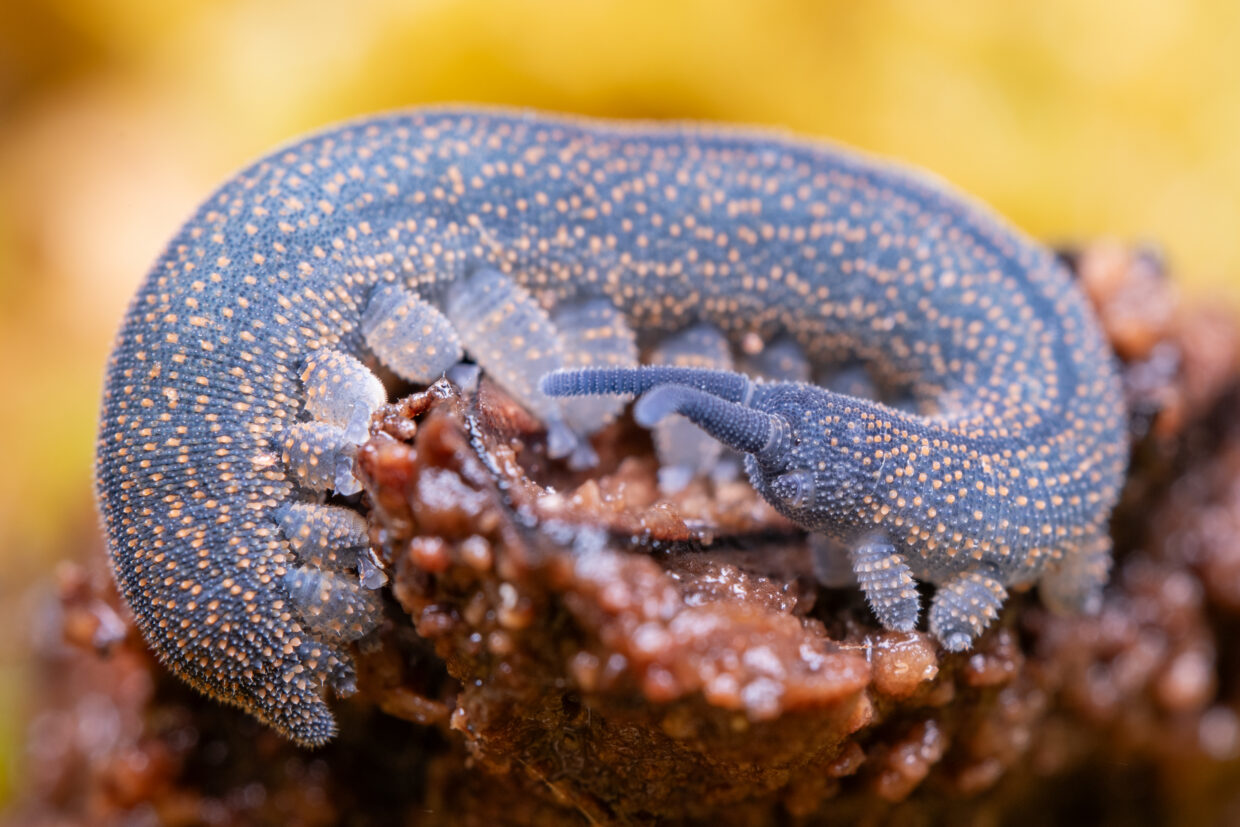 Velvet worms have changed very little in over 400 million years, still closely resembling their Cambrian marine ancestors. Photo by Frank Ashwood.
Around 2.1 billion years ago, the “Great Oxidation Event” happened. Thanks to the “invention” of photosynthesis by marine cyanobacteria in the form of these stromatolites, the oxygen they produced had finally saturated the oceans, and now began to diffuse into the Earth’s atmosphere, eventually nudging out methane as a dominant atmospheric gas. This probably sounds great to us air-breathers, but it was pure poison to most other microbial life on Earth at the time, which was anaerobic and used chemicals other than oxygen to obtain energy (much like the sulfur-based microbes we still find today on deep-sea hydrothermal vents).
Sekitar 2,1 miliar tahun yang lalu, terjadi “Peristiwa Oksidasi Besar”. Berkat “penemuan” fotosintesis oleh bakteri sianobakteri laut dalam bentuk stromatolit, oksigen yang mereka hasilkan akhirnya memenuhi samudra, dan sekarang mulai merembes ke atmosfer Bumi, pada akhirnya menggantikan metana sebagai gas atmosfer dominan. Ini mungkin terdengar hebat bagi kita yang bernapas udara, tetapi itu adalah racun bagi kebanyakan kehidupan mikroba lain di Bumi pada saat itu, yang anaerobik dan menggunakan zat kimia selain oksigen untuk mendapatkan energi (mirip dengan mikroba berbasis belerang yang masih kita temukan hari ini di vent hidrotermal laut dalam).
This was perhaps the planet’s first mass extinction event. The stromatolites themselves managed to adapt to the new conditions and survive. With methane—a potent greenhouse gas—ousted from the atmosphere, and the creation of the UV-protective ozone layer (which still shields us from the sun’s rays today), the Earth began to cool and experienced one of its earliest ice ages. Under the increased oxygen levels, the planet’s early pre-soils developed a reddish hue, as the chemical process of oxidation occurred. Thanks to a billion years of work by tiny single-celled cyanobacteria, the trajectory of life on Earth permanently shifted in favor of aerobic (oxygen-based) organisms and, eventually, multicellular life. We humans owe our entire existence to lumpy microbial mats such as those still found at Hamelin Bay.
Ini mungkin merupakan kejadian kepunahan massal pertama di planet ini. Stromatolit itu sendiri berhasil beradaptasi dengan kondisi baru dan bertahan hidup. Dengan metana—gas rumah kaca yang kuat—keluar dari atmosfer, dan terbentuknya lapisan ozon yang melindungi UV (yang hingga hari ini masih melindungi kita dari sinar matahari), Bumi mulai mendingin dan mengalami salah satu zaman es pertama. Di bawah peningkatan kadar oksigen, tanah purba planet ini berkembang menjadi kemerahan karena proses oksidasi kimia. Berkat satu miliar tahun kerja bakteri sianobakteria bersel tunggal kecil, trajektori kehidupan di Bumi secara permanen bergeser ke arah organisme aerobik (berbasis oksigen) dan, akhirnya, kehidupan multiseluler. Kita manusia berhutang pada seluruh eksistensi kita pada matriks mikroba yang berbentuk seperti gumpalan, seperti yang masih ditemukan di Hamelin Bay.
Over the course of the next billion years, life on Earth slowly began to take shape. The earliest “soils” may have begun forming billions of years ago, although they did not resemble what we call soil today. Those first examples were devoid of plants or animals and had developed in an atmosphere without oxygen. There are several ways in which soil can develop, and the study of that development is called pedogenesis (from the Greek pedon, meaning “earth,” and genesis, meaning “origin”).
Selama satu miliar tahun berikutnya, kehidupan di Bumi perlahan mulai membentuk dirinya. Tanah “pertama” mungkin mulai terbentuk miliaran tahun yang lalu, meskipun mereka tidak menyerupai apa yang kita sebut tanah sekarang. Contoh-contoh awal itu tidak memiliki tumbuhan atau hewan dan telah berkembang dalam atmosfer tanpa oksigen. Ada beberapa cara tanah dapat berkembang, dan studi tentang perkembangan itu disebut pedogenesis (dari bahasa Yunani kuno pedon, yang berarti “bumi,” dan genesis, yang berarti “asal-usul”).
Historically, five major factors interacted to create soil: parent material (the origin of the mineral component), climate, topography (influencing weathering, depth, and the liquid component), biology (the organic content), and time. In the current age of the Anthropocene, we could easily add in human activity as a sixth and new soil-forming factor, affecting all others.
Secara historis, lima faktor utama saling berinteraksi untuk menciptakan tanah: material induk (asal-usul komponen mineral), iklim, topografi (mempengaruhi pelapukan, kedalaman, dan komponen cair), biologi (kandungan organik), dan waktu. Dalam era Anthropocene saat ini, kita dengan mudah bisa menambahkan aktivitas manusia sebagai faktor keenam dan baru yang membentuk tanah, memengaruhi semua faktor lainnya.
Modern soils are produced by biological weathering of rocks, with the mineral component coming from the bedrock (or “C-horizon”). Over time, these rocks are fragmented and broken up into small mineral particles by plant roots forcing open cracks, or lichens secreting chemicals that dissolve rocks to release nutrients. However, these very early soils were instead chemically weathered by water and possibly atmospheric gases. Interestingly, similarly aged chemically weathered “paleosols” have been found on Mars, suggesting that early soil formation processes happen elsewhere in the galaxy and perhaps even across the entire universe. These paleosols are separated from true soil due to the lack of one key ingredient: organic matter.
Tanah modern dihasilkan melalui pelapukan biologis batuan, dengan komponen mineral berasal dari batuan induk (atau “C-horizon”). Seiring waktu, batuan ini dipecah menjadi partikel mineral kecil oleh akar tanaman yang membelah retakan, atau lumut yang mengeluarkan bahan kimia yang melarutkan batu untuk melepaskan nutrisi. Namun tanah sangat awal ini justru mengalami pelapukan kimia oleh air dan mungkin gas atmosfer. Menariknya, paleosol berusia serupa juga telah ditemukan di Mars, menunjukkan bahwa proses pembentukan tanah awal terjadi di tempat lain di galaksi dan mungkin bahkan di seluruh alam semesta. Paleosol ini terpisah dari tanah sejati karena ketiadaan satu unsur kunci: bahan organik.
These first colonizers affixed themselves to the bare rocky ground with a new and game-changing innovation: roots.
Para kolonis pertama menempelkan diri pada tanah batu yang terbuka dengan inovasi baru yang mengubah permainan: akar. These small hair-like strings weren’t roots in the modern sense (technically, they are called “rhizoids”), but they did the job of anchoring these early plants to substrates. Even now, modern mosses and liverworts still have rhizoids rather than the complex, burrowing roots of vascular plants. The rhizoids accidentally did something else too: by trapping debris and through dying and decomposing, they inadvertently began the process of real soil development for the first time in the Earth’s history.
“Massa akar” pertama menempelkan diri mereka pada tanah batu yang bare dengan inovasi baru yang mengubah permainan: akar. Tali berukuran kecil seperti rambut ini bukan akar dalam arti modern (secara teknis disebut “rhizoid”), tetapi mereka melakukan tugas menambat tumbuhan awal ini ke substrat. Bahkan sekarang, lumut dan liverwort modern masih memiliki rhizoids daripada akar kompleks yang menggali milik tumbuhan vaskular. Rhizoids secara tidak sengaja juga melakukan hal lain: dengan menjebak puing-puing dan melalui kematian serta peluruhan, mereka secara tidak sengaja memulai proses pembentukan tanah nyata untuk pertama kalinya dalam sejarah Bumi.
Soil organic matter is a rich substance created by the decomposition of the carbon-rich litter layer above it, forming a layer that soil scientists call the O-horizon. Here, heavily decaying plant and animal remains are broken down into their constituent parts, sometimes to a point that they are completely unrecognizable from their original form—creating a specific and sometimes long-lasting type of organic matter called humus. Packed with nutrients like nitrogen, which is a key part of plants’ diets, soil organic matter is the lifeblood of the pedosphere. A by-product of decay, soil organic matter takes myriad forms.
Bahan organik tanah adalah zat kaya yang terbentuk dari dekomposisi lapisan litter kaya karbon di atasnya, membentuk lapisan yang oleh ilmuwan tanah disebut horizon O. Di sini sisa tumbuhan dan hewan yang sangat terurai diuraikan menjadi bagian-bagiannya, terkadang hingga tidak lagi dapat dikenali dari bentuk aslinya—menciptakan jenis bahan organik tertentu yang kadang-kadang bertahan lama yang disebut humus. Dipenuhi nutrisi seperti nitrogen, yang merupakan bagian kunci dari makanan tumbuhan, bahan organik tanah adalah nadi pedosfer. Sebuah produk sampingan dari peluruhan, bahan organik tanah mengambil banyak bentuk.
Environmental conditions, origin material, and the activity of soil organisms all interact to determine the quality and quantity of organic matter, and the depth of the O-horizon, in any soil. Soils, and particularly their organic component, are often referred to as a “black box” because of their opacity and inherent complexity, and because of the difficulty scientists have in unraveling the multilayered biological interactions going on within them. The term is perhaps better known when used to describe an aircraft’s data and audio flight recording devices. In a similar way to that black box, soil organic matter holds an enduring record of the past.
Kondisi lingkungan, bahan asal, dan aktivitas organisme tanah semuanya saling interaksi untuk menentukan kualitas dan kuantitas bahan organik, serta kedalaman horizon O, di tanah mana pun. Tanah, dan terutama komponen organiknya, sering disebut sebagai “kotak hitam” karena ketidaktransparan dan kompleksitas bawaan, serta karena kesulitan para ilmuwan dalam mengurai interaksi biologis berlapis yang terjadi di dalamnya. Istilah ini mungkin lebih dikenal ketika digunakan untuk menggambarkan perangkat perekaman data dan audio pesawat terbang. Seperti kotak hitam itu, bahan organik tanah menyimpan rekaman abadi masa lalu.
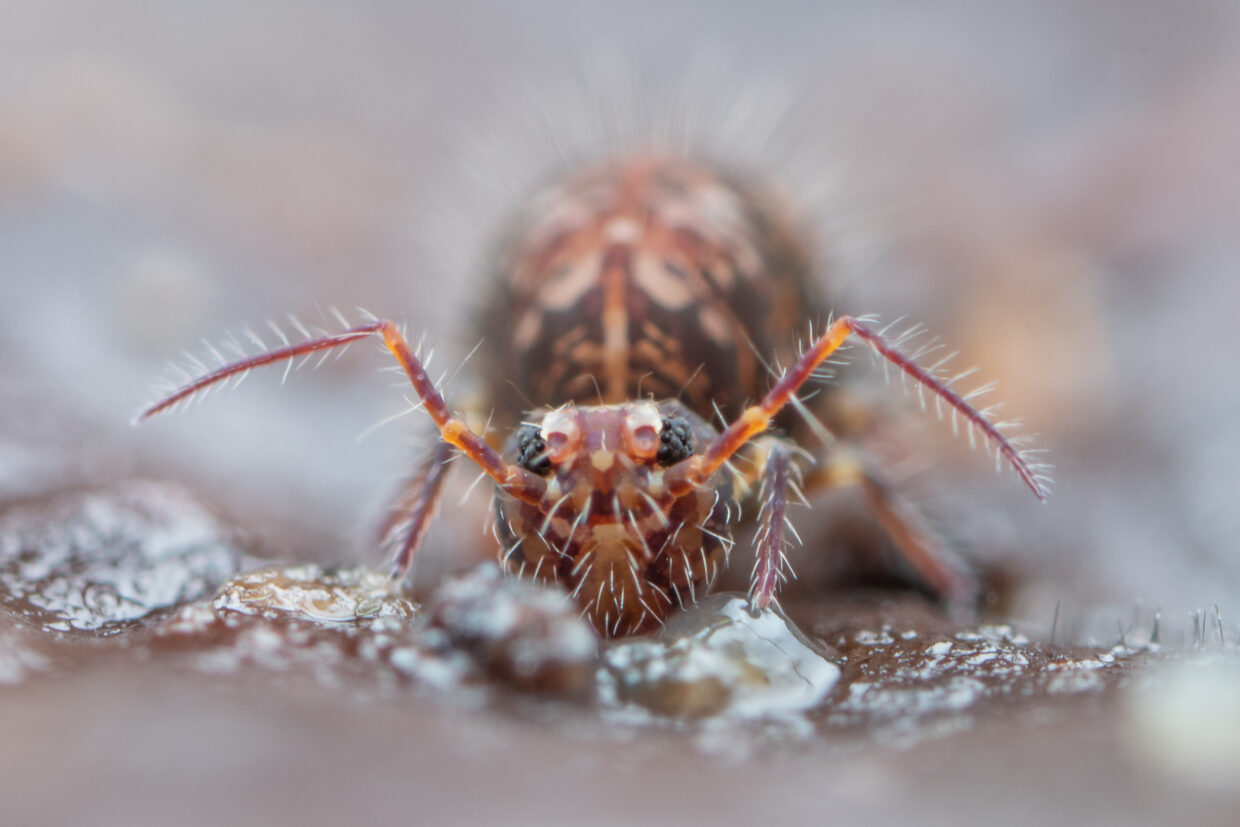 Springtails are the earliest known pollinators, distributing spores from the first land plants. Photo by Frank Ashwood.
Sometime around 470 million years ago, in the increasingly oxygen-rich environment of the Middle Ordovician period, life on Earth was forever changed once again with the emergence of the first land plants. These earliest plants evolved from water-living multicellular green algae—descendants of the cyanobacteria—and reproduced using spores. Lacking the specialized structures for transporting fluids and nutrients found in modern “vascular” plants, they would have resembled bryophytes (the group to which mosses and liverworts belong).
Sekitar 470 juta tahun yang lalu, di lingkungan yang semakin kaya oksigen pada periode Ordovisium Tengah, kehidupan di Bumi kembali berubah selamanya dengan munculnya tumbuhan darat pertama. Tanaman awal ini berevolusi dari alga hijau multiseluler yang hidup di air—keturunan dari sianobakteri—dan berkembang biak menggunakan spora. Karena tidak memiliki struktur khusus untuk mengangkut cairan dan nutrisi seperti yang dimiliki tumbuhan vaskular modern, mereka akan menyerupai bryofita (kelompok yang mencakup lumut dan liverwort).
These first colonizers affixed themselves to the bare rocky ground with a new and game-changing innovation: roots. These small hair-like strings weren’t roots in the modern sense (technically, they are called “rhizoids”), but they did the job of anchoring these early plants to substrates. Even now, modern mosses and liverworts still have rhizoids rather than the complex, burrowing roots of vascular plants. The rhizoids accidentally did something else too: by trapping debris and through dying and decomposing, they inadvertently began the process of real soil development for the first time in the Earth’s history.
Para kolonis pertama menempelkan diri pada tanah batu yang telanjang dengan inovasi baru yang mengubah permainan: akar. Tali berukuran kecil seperti rambut ini bukan akar dalam arti modern (secara teknis disebut “rhizoid”), tetapi mereka melakukan tugas menambat tumbuhan awal ini ke substrat. Bahkan sekarang, lumut dan liverwort modern masih memiliki rhizoids daripada akar kompleks yang menggali milik tumbuhan vaskular. Rhizoids secara tidak sengaja juga melakukan hal lain: dengan menjebak puing-puing dan melalui kematian serta peluruhan, mereka secara tidak sengaja memulai proses pembentukan tanah nyata untuk pertama kalinya dalam sejarah Bumi.
Within 80 or so million years—the blink of an eye in geological terms—the first transitional forms between bryophytes and vascular plants had emerged, including ferns. The first forests had spread across the land, dominated by the earliest woody trees, called Cladoxylopsida. The tapering, hollow-trunked trees stood up to four meters in height, and could be a meter wide at their swollen base. Instead of leaves, they had a crown of branching twig-like structures, which rained down to the ground, providing food for detritivorous arthropods and becoming the earliest form of deadwood. Even more crucially for early soil development, they possessed downward-pointing roots, which stabilized the ground and rapidly began soil development as we know it today.
Dalam sekitar 80 juta tahun, yang sekejap saja dalam istilah geologi, bentuk-bentuk transisi pertama antara bryophyta dan tumbuhan vaskular telah muncul, termasuk pakis. Hutan pertama telah menyebar di darat, didominasi oleh pohon-pohon kayu tertua, yang disebut Cladoxylopsida. Pohon-pohon yang meruncing dengan batang berongga itu setinggi hingga empat meter, dan bisa selebar satu meter pada pangkal yang membesar. Alih-alih daun, mereka memiliki mahkota cabang-cabang seperti ranting, yang berjatuhan ke tanah, menyediakan makanan bagi arthropoda detritivora dan menjadi bentuk awal dari kayu mati. Yang lebih krusial untuk pembentukan tanah awal, mereka memiliki akar yang mengarah ke bawah, yang menstabilkan tanah dan dengan cepat memulai pembentukan tanah seperti yang kita kenal sekarang.
Although it’s way past our bedtime, finally, at 11:59:59 p.m., a second before midnight, humans appear on the planet and start undoing all the hard work.
Meskipun jam biologis kita sudah lewat, akhirnya, pada pukul 23:59:59, satu detik sebelum tengah malam, manusia muncul di planet ini dan mulai membalikkan semua kerja keras.
This “root revolution” fundamentally changed the structure of the land’s surface through soil creation, which had massive knock-on effects for the water and carbon cycles. The first meandering rivers and floodplains developed as tree roots stabilized soil and prevented its erosion, while at the same time locking away vast amounts of atmospheric carbon into the nascent soils. This reduced atmospheric carbon dioxide levels and turned soil into the first terrestrial carbon sinks. The evolution of land plants and the development of soil go hand in hand—as these pioneering plants, trees, and animals died and their decomposing remains were recycled on land, by fungi and the first soil invertebrates, modern soils began to form.
“Revolusi akar” ini secara mendasar mengubah struktur permukaan daratan melalui pembentukan tanah, yang memiliki dampak besar pada sirkulasi air dan karbon. Sungai-sungai berkelok pertama dan dataran banjir berkembang ketika akar pohon menstabilkan tanah dan mencegah erosi, sambil pada saat yang sama mengunci sejumlah besar karbon atmosfer ke dalam tanah yang baru terbentuk. Hal ini menurunkan tingkat karbon dioksida atmosfer dan menjadikan tanah sebagai penampung karbon pertama di darat. Evolusi tumbuhan darat dan pengembangan tanah berjalan seiring—seiring tumbuhnya tumbuhan, pohon, dan hewan perintis ini yang mati dan sisa-sisa pembusukan mereka didaur ulang di darat, oleh jamur dan invertebrata tanah pertama, tanah modern mulai terbentuk.
To help visualize the development of soil and its biodiversity on the Earth, let’s consider our planet’s history in terms of a single day, with the formation of the planet (4.54 billion years ago) starting the clock at midnight. Every minute represents roughly 3.15 million years. Roughly half a billion years after the Earth’s formation, at 2:38 a.m. on our clock, the Earth’s crust has cooled and solidified, and water and atmospheric gases have begun chemically driven weathering of exposed rocks to produce the first loose mineral particles, a biologically sterile precursor to soil.
Untuk membantu memvisualisasikan perkembangan tanah dan keanekaragaman hayatinya di Bumi, mari kita mempertimbangkan sejarah planet kita dalam bentuk satu hari tunggal, dengan pembentukan planet (4,54 miliar tahun yang lalu) memulai jam pada tengah malam. Setiap menit mewakili sekitar 3,15 juta tahun. Sekitar setengah miliar tahun setelah pembentukan Bumi, pada pukul 2:38 pagi pada jam kita, kerak Bumi telah mendingin dan mengeras, dan air serta gas atmosfer telah mulai melarutkan pelapukan kimia pada batuan yang terbuka untuk menghasilkan partikel mineral longgar pertama, pendahulu biologis dari tanah.
Our alarm clock rudely goes off at around 5:10 a.m., and we pull back the curtains to see marine cyanobacteria beginning to spread across the planet’s coastal areas as stromatolite microbial mats, pumping oxygen into the shallow oceans. Late morning—11:00 a.m.—brings much excitement, as the Great Oxidation Event wipes out a significant proportion of the planet’s biodiversity, and reorients the evolution of life in a new oxygen-loving direction.
Alarm kami secara ceroboh berbunyi sekitar pukul 5:10 pagi, dan kami menarik tirai untuk melihat sianobakteri laut mulai menyebar di wilayah pesisir planet ini sebagai mat mikroba stromatolit, memompa oksigen ke lautan dangkal. Menjelang pagi—pukul 11:00 pagi—membawa banyak kegembiraan, saat Peristiwa Oksidasi Besar membasmi sebagian besar keanekaragaman hayati planet ini, dan mengarahkan evolusi kehidupan ke arah yang baru yang menyukai oksigen.
Much of the afternoon is then spent watching microbes fart, as the Earth goes through a protractedly dull billion-year period known as the “boring billion” to paleontologists (approximately 1:20 p.m. to 6:30 p.m.). This phase is notable mainly for the emergence of early algae, fungi, and invertebrate animals toward its end.
Sebagian besar siang hari berikutnya dihabiskan dengan menyaksikan mikroba buang gas, saat Bumi melewati periode satu miliar tahun yang membosankan bagi para paleontolog (sekitar pukul 1:20 siang hingga 6:30 sore). Fase ini terutama terkenal karena munculnya alga awal, jamur, dan hewan invertebrata mendekati akhirnya.
By about 9:15 p.m., during the Cambrian explosion, marine arthropods—some of the first complex animals—had evolved and diversified in the oceans. The descendants of the algae, the early bryophytes, eventually colonize the land at 9:30 p.m. and begin contributing organic matter to the loose mineral particles. Soil formation properly begins now, but it is a slow process. At 9:58 p.m., the first forests spread across the planet, their litter and deep root systems rapidly accelerating soil development into a form recognizable to us today. They are shortly followed, at 10:00 p.m., by our ancestors, the marine vertebrates, crawling up onto the land. Although it’s way past our bedtime, finally, at 11:59:59 p.m., a second before midnight, humans appear on the planet and start undoing all the hard work.
Sekitar pukul 21:15 malam, selama ledakan Cambrian, arthropoda laut—beberapa hewan kompleks pertama—telah berevolusi dan berkembang biak di lautan. Keturunan alga, bryophyta awal, akhirnya mengkolonisasi daratan pada pukul 21:30 malam dan mulai berkontribusi pada bahan organik ke partikel mineral longgar. Pembentukan tanah mulai benar-benar sekarang, tetapi prosesnya lambat. Pada pukul 21:58 malam, hutan pertama menyebar di planet ini, daun sisa dan sistem akar dalam mereka dengan cepat mempercepat pembentukan tanah menjadi bentuk yang kita kenal sekarang. Mereka diikuti tidak lama kemudian, pada pukul 22:00 malam, oleh nenek moyang kita, vertebrata marin, merayap ke darat. Meskipun ini sudah lewat waktu tidur kita, akhirnya, pada pukul 23:59:59 malam, satu detik sebelum tengah malam, manusia muncul di planet ini dan mulai membalikkan semua kerja keras.
__________________________________
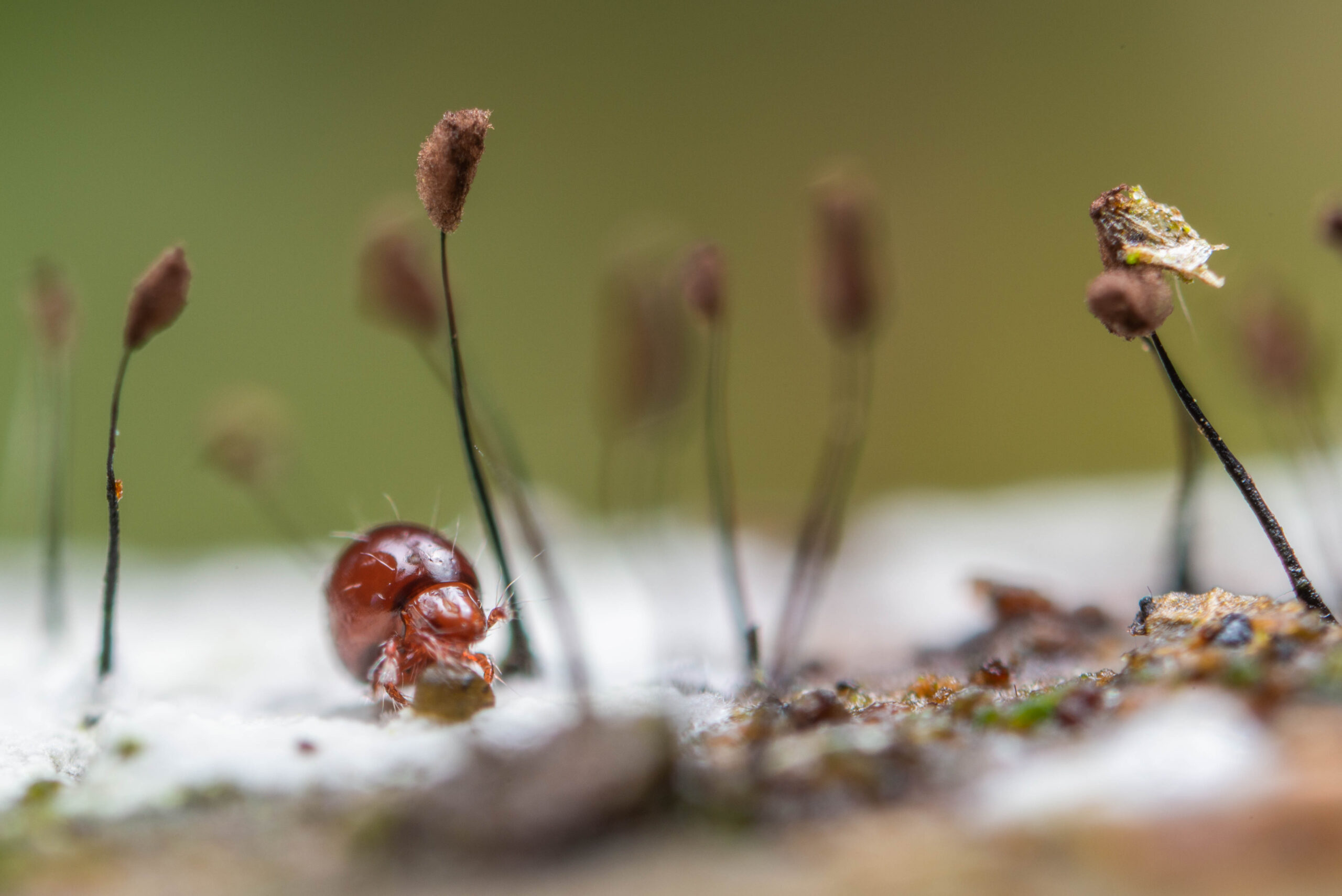
Excerpted from The World Beneath Our Feet by Frank Ashwood. Copyright © 2026 by Frank Ashwood. All rights reserved. No part of this excerpt may be reproduced or reprinted without permission in writing from the publisher. Feature image of mites–one of the earliest known terrestrial animals that help to decompose organic matter–by Frank Ashwood.