Ragam ulasan lezat kami minggu ini mencakup Anahid Nersessian tentang Ashton Politanoff’s Dad Had a Bad Day, Peter Beinart tentang Akbar Shahid Ahmed’s Crossing the Red Line, Jennifer Wilson tentang Lars Anderson’s Brady, Sanjena Sathian tentang Min Jin Lee’s American Hagwon, dan Jeff VanderMeer tentang China Miéville’s The Rouse.
Brought to you by Book Marks, Lit Hub’s home for book reviews.
*

“Here are sad dads and washed-up jocks, suburbanites in their thirties and forties dipping their toes into the manosphere by embracing its protocols of relentless self-optimization (also known as ‘maxxing’). They lift weights, chug shakes, and play tennis until they puke, then drink too many beers at the club’s restaurant. Many of them, including Ned and his childhood friend and rival, Roland, are scarred by their time as youth players, haunted by memories of the sadistic coaches and cruel, competitive fathers who terrorized them both on and off the court. Masculinity, in this novel, is an inheritance of anguish and misadventure—one battle after another in which boy is pitted against boy and then man against man, all of them vying for a phantom ideal of total immunity from the frustrations and injustices of ordinary life.
…
“Politanoff himself was once a Division I tennis player, and his terse, ominous prose is stippled with technical terms and sports slang, whizzing by like so many Dunlop ATPs. Players will hit ‘a slice, a drive, a heavy ball, a drop shot’ or ‘a nice ice-cream floater.’ His unnumbered chapters are short, but a lot happens in each one—not unlike, you might say, a tennis match, where the governing tension between a compact field of play and balls that can reach speeds of more than 150 miles per hour creates an environment at once tightly contained and incredibly volatile. In the space of a few paragraphs, Ned will abandon and recover his child, bungle an extramarital affair, win and lose, experience ecstasy and dejection. He is high on his own poor choices, which, for all their stupidity, seem to bring a much-needed urgency to his disappointed life.
…
“Ned aspires to be an Übermensch: a superior human specimen whose body has been engineered for excellence, supercharged by nut milks and purged of undesirable elements, from foot fungus to negative thoughts. It is an identity in conflict with his role as a twenty-first-century parent, which requires him to be a gentle, endlessly patient caretaker who apologizes when he yells and stays in the bathroom with Freddie while the boy shits—a ‘mother bird,’ as Ned puts it, instead of an alpha male. There is no question that disagreeable, even dangerous attitudes toward masculinity play a significant part in Politanoff’s novel, which is propelled by Ned’s realization that he can no longer bear being a stay-at-home dad in a sexless marriage. But in its preoccupation with what Politanoff calls the ‘abject-adjacent features’ of manospheric culture, Dad Had a Bad Day also has something in common with Ottessa Moshfegh’s My Year of Rest and Relaxation (2018) and Yasmin Zaher’s The Coin (2024), books that similarly test the boundary between self-care and self-destruction.
…
“For all that it satirizes male delusion and middle-class ennui, Dad Had a Bad Day stops short of political critique, which allows it to maintain its light touch. There are moments, however, when it seems to point toward a better life than the one Ned feverishly pursues, riven as it is by competition over women, resources, and self-respect. Some of these moments involve Ned’s imperfect yet still undeniably loving rapport with his son. Others foreground his tenderness toward other men. Ned calls this tenderness ‘a kinship,’ but occasionally it seems like erotic interest . . . These sensual glimmers are no match for the antagonistic sociality of straight male relationships, which, in this novel, quickly convert sympathy or desire into rivalry and aggression. Inevitably, the camaraderie between Ned and his teammates will sour, sometimes turning violent; just as inevitably, his secret hobby will be discovered, his marriage imperiled, his delusions exposed. All the same, his carnal curiosity about other men feels far more urgent than his frustrated longing for his wife, who brushes off his advances and masturbates in the shower, or the female club member with whom he almost has an affair. Other than Ned’s love for his son, it is the only thing in his world that isn’t ugly—or expensive. Perhaps in another lifetime, or another novel, Ned would find a way to nourish these intimations of benevolence or even love, refusing to let them be spoiled by his own aspirational machismo. Unfortunately, he is not that kind of guy.”
–Anahid Nersessian on Ashton Politanoff’s Dad Had a Bad Day (New York Review of Books)
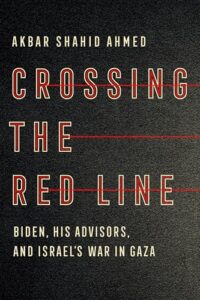
“If one photo explains the tremors currently convulsing the Democratic Party, it is this one: In November 2023, a group of hunger strikers stands outside the White House. They carry a banner that reads ‘Biden, you are starving Gaza.’ On the right, wearing a gray suit and black shirt, is an obscure New York state assemblyman named Zohran Mamdani. The image captures the Democratic establishment’s problem. It wants to unite the party against Donald Trump. But it now faces a leftist insurgency, embodied by Mayor Mamdani, which views Joe Biden’s policy toward Gaza as reflecting a rot inside the Democratic Party itself. In his indispensable new book, Crossing the Red Line, the journalist Akbar Shahid Ahmed shows how we got here. Ahmed doesn’t merely document the decisions that led President Biden and his aides to arm and rationalize what leading human rights organizations and legal scholars now consider a genocide. He also illuminates the habits of mind that underlay those decisions—habits that will require a political revolution if the Democrats want to uproot them.”
…
“Viewing Israel’s fight as another war on terror didn’t prevent the Biden administration from critiquing Israel’s actions, Ahmed suggests, but it circumscribed the nature of those criticisms. When Biden spoke in Tel Aviv on Oct. 18, he told Israelis to learn from America’s ‘mistakes,’ a far softer term than the one that human rights groups had begun using to describe Israel’s blockade of Gaza and mass evacuation orders: war crimes. Ahmed also offers a glimpse into just how entangled the Biden White House was with lobbyists and donors who wanted to ensure that Israel enjoyed a free hand. One of the people whom Biden and his advisers consulted on the morning of Oct. 7 was the president’s political strategist, Anita Dunn, who had helped found a public relations firm that in December 2023 began working for AIPAC and other pro-Israel groups. The following May, Sullivan’s wife, Maggie Goodlander, launched a bid for Congress in which she raised more than $100,000 from pro-Israel donors.”
…
This electoral miscalculation, and moral blindness, has now unleashed a revolt inside the Democratic Party with only two modern parallels. The first is the backlash against the war in Vietnam, which in 1972 helped George McGovern win the nomination for president. The second is the backlash against the war in Iraq, which in 2008 helped Barack Obama achieve the same. McGovern lost, Obama won—but Obama won the presidency without transforming the Democratic foreign-policy class. He chose a vice president, Joe Biden, and a secretary of state, Hillary Clinton, who had supported the war he opposed. In crucial ways, Obama’s appointments laid the foundation for America’s response to Oct. 7. The challenge facing Zohran Mamdani, and the other activists who launched that hunger strike in 2023, is whether they can succeed where he failed.”
–Peter Beinart on Akbar Shahid Ahmed’s Crossing the Red Line: Biden, His Advisors, and Israel’s War in Gaza (The New York Times Book Review)
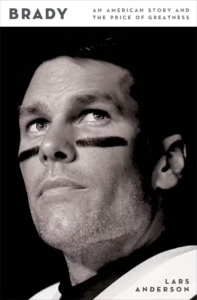
“…I didn’t expect Brady: An American Story and the Price of Greatness, a new biography by the former Sports Illustrated journalist Lars Anderson, to tell the story of Touchdown Tom’s life through the prism of his divorce. The book—surprisingly intimate despite the fact that Anderson didn’t have access to the golden couple—reads like Scenes from a Marriage with a lot more blitzing. It opens with Bündchen and Brady’s first date, in 2006, at the West Village wine bar Turks & Frogs. Anderson writes with exactly the amount of restraint you’d expect of a man whose subjects are a football legend and a Victoria’s Secret model, which is to say—he leaves every metaphor on the field. That night, Bündchen’s eyes were ‘the mossy green of a primeval forest’ while Brady’s were ‘the glacial blue of a winter sky.’ Over drinks, he tells her that he intends to play for ten more years and would be happy to win just one more Super Bowl. Anderson tries to understand why, in the end, Brady couldn’t stick to the game plan, even when the woman whose teeth ‘glistened with the flawless geometry of freshly fallen snow’ asked him to.”
…
“I’m a fan of books about sports. (I once almost created a podcast on the subject; I planned to call it ‘The Bookie.’) The best ones situate athletes in history. Buzz Bissinger’s Friday Night Lights is about high-school football the way that the documentary Hoop Dreams is about basketball. Both capture the shrinking aperture of opportunity in a country founded on the idea of limitless possibility. David Maraniss’s Path Lit by Lightning: The Life of Jim Thorpe considers how the Native American football legend wrestled with what it meant to be ‘all-American.’ The ambitions of Anderson’s book are slight by comparison, its stakes those of a preseason game. Brady is a man who began playing professionally at the dawn of a new millennium, but you wouldn’t know it here.”
…
“There’s no sense in Anderson’s book that Brady is a man of our age, except in the worst possible ways. Brady could choose when to retire, but some of his own fans were deprived of that option. Michael Livieratos, a Patriots supporter, put his life savings into FTX after seeing his hero promote the cryptocurrency firm. (Sam Bankman-Fried paid Brady fifty-five million dollars for sixty hours of promotional work, and Gisele eighteen million to appear alongside her husband.) No, the big question of the book seems to be this: Can a man really claim that he’s won it all if he fumbled Gisele? I must confess I took some pleasure in seeing a man subjected to the narrative that the end of his marriage is a life-defining moment, his most important story. If he were a woman, this book would be a best-selling memoir.”
Dalam akhirnya, keberatan Bündchen terhadap hasrat Brady yang tidak terpuaskan untuk lebih banyak—lebih banyak cincin, lebih banyak kemenangan, lebih banyak rekor—memberi bobot pada buku ini. Brady pensiun pada usia empat puluh lima, ketika ia adalah quarterback starter tertua dalam sejarah NFL. Ia bermain di musim-musim terakhirnya bersama Tampa Bay, yang bisa saya pahami; mungkin ia berharap bisa membuktikan bahwa ia bisa memenangkan Super Bowl tanpa Belichick, dan ia melakukannya. Tetapi ia ingin satu lagi, dan satu lagi—yang, bisa diperdebatkan, menghubungkannya dengan momen ini di negara kita, ketika pencarian untuk lebih tidak lagi dianggap melanggar batas. Dalam Tom vs. Time, Bündchen berkata kepada kamera bahwa sepak bola adalah cinta pertama suaminya. ‘Dan saya pikir itu, seperti, cintanya yang utama, benar-benar,’ tambahnya. Brady bercanda bahwa jika dia mempunyai pilihannya, setelah kemenangannya di Super Bowl LI pasangan ini akan pindah ke Kosta Rika, tempat belakangan ini ia terlihat berjalan berpegangan tangan di pantai bersama Valente. Dia sudah lelah dengan ‘kisah Amerika’ ini. Berapa kali lagi dia bisa berkata, Cukup, kau sudah cukup.”
–Jennifer Wilson on Lars Anderson’s Brady: An American Story and the Price of Greatness (The New Yorker)
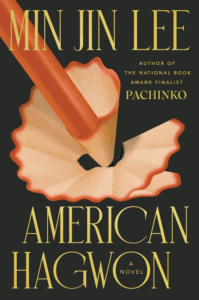
“Such questions of power and privilege are among the most important ones that new Americans, particularly those of us cast as ‘model minorities,’ can ask. We strive to belong, but what kind of country should we hope to belong to? Is education a conservative force that makes minorities compliant? Or is it a liberating force that can cause us to make trouble? American Hagwon is oddly incurious about these questions. Instead, it is a morality tale. And its morality is the respectability politics of the model minority.”
…
Sympathetic realism, writes scholar Rae Greiner, ‘mobilizes the imagination,’ inspiring readers ‘to imagine what it’s like to be somebody else, somewhere else entirely.’ Greiner dates the form to the 19th century fiction of George Eliot, Jane Austen, and Charles Dickens—the literature that shaped Lee. Lee’s work is particularly indebted to Eliot, with whom she shares a proclivity for long, realist, omnisciently narrated books—art which, as Eliot once put it, can ‘enlarge men’s sympathies.’ For both writers, this ethical vision of fiction is influenced by Protestantism: Lee, the granddaughter of a Presbyterian minister, has said that she reads the Bible daily and speaks earnestly about a desire to ‘be wise’; Eliot was an ex-Evangelical who, as the critic James Wood has written, used the novel to ask secular versions of Christian questions about goodness. Lee’s fiction, like 19th-century novels, seeks to engender sympathy by paying close attention to the lives of many varied characters. Indeed, Lee has historically displayed a talent for omniscient narration.
…
Lee’s attempts to cast her protagonists in the best possible light is understandable. Many writers like their characters and want to protect them from outsiders’ scrutiny. But good fiction requires novelists to step beyond niceness and toward some richer mix of curiosity and compassion. Those complexities come out in line-level choices. Compare Lee’s narration to Eliot’s: Eliot sometimes described her protagonists flatteringly, as in her characterization of the religiously idealistic Dorothea in Middlemarch: ‘open, ardent, and not in the least self-admiring.’ But Eliot also uses free indirect discourse, the technique in which an omniscient narrator adopts the perspective of an individual character, to inhabit Dorothea beyond her surface qualities. Reflecting on Dorothea’s marital aspirations, Eliot writes, ‘The really delightful marriage must be that where your husband was a sort of father.’ Eliot indulges in true omniscience, placing Dorothea in a broader social context—she is ‘likely to seek martyrdom, to make retractions, and then to incur martyrdom after all in a quarter where she had not sought it.’ When novelists pair sympathetic free indirect discourse with critical omniscience, they can enlarge readers’ sympathies and say something wise. For Eliot, paying attention to both the inner lives of her characters and the world in which they operate lets her capture the way striving—for marriage, for power, even for God Himself—can corrupt the soul. But, in Hagwon, Lee does not seem interested in the ways in which her diplomatic, kind, generous characters might be corrupted. Instead, she seems to want us to see her protagonists as incorruptible.”
…
“It is tempting, in tumultuous times like our own, for writers to write nice characters who are simply lovable but not dislikable—figures a reader can easily ‘root for.’ A writer’s instinct to reach for goodness can be productive: Lee’s interest in enlarging our sympathies is her strongest artistic power. But what is the point of trying to enlarge our sympathies if a writer reserves such gestures for ethically perfect people? Sympathetic realism is at its wisest when novelists give readers the chance Lee offered in her first book— to love and dislike characters simultaneously.”
–Sanjena Sathian on Min Jin Lee’s American Hagwon (Vulture)
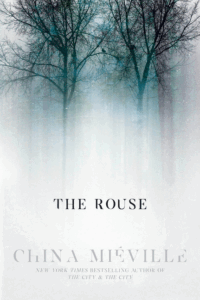
“The opening section, almost a self-contained novella, chronicles the lives of a single mother named Maur and her son, Ewan (called Yew, after the trees he loves), who is obsessed with a strange house down the street. He joins the Royal Air Force in the 1990s, serves in the Balkans and perishes under mysterious circumstances. I can think of fewer more indelible portraits of a mother-son relationship in literature; it is a stunning display of interiority and brilliant writing.
…
“If The Rouse sometimes reads like John le Carré’s A Perfect Spy by way of J.G. Ballard and Max Lury, Miéville transcends those comparisons with unparalleled lunges of thought about the spirit world that leave one breathless with their audacity. Literature itself becomes weaponized, part of the summoning of the dead…
…
“There is an emotional cadence, and even a rough joy, that enlivens what one might label exposition or theory—a searing incandescence illuminating the weightier material, like a pulsing line of red on metal being worked in a foundry. ‘Killing is ontologically simpler,’ Croome says at one point. ‘You can’t kill something that’s not alive.’ The academic language in the novel becomes urgent. Miéville is able to flex certain muscles—perilous for most fiction writers—in ways that support the dramatic tension rather than drain it.
…
“I’ve rarely read scenes so terrifying, achieved with a kind of stutter-step language, words that intensify and recede with such incantatory power. These passages seem unparalleled in literature and somehow bypass the brain to jolt the nervous system directly. Over its 1,200 pages, the novel becomes a haunting of a haunting, a terror echoed and heightened over time. This terror grows familiar but not stale; the reader is allowed to live within it almost calmly and thus catch glimpses of other forces in the darkness.”
What Miéville has crafted in The Rouse is an intimate epic, a controlled sprawl of history and emotional resonance. I felt it in my bones, the undeniable power of a jagged masterpiece.”
–Jeff VanderMeer on China Miéville’s The Rouse (The New York Times Book Review)