Our five-alarm fire of fabulous reviews this week includes Andrew Martin on Patrick deWitt’s Dodge City, Zito Madu on Chuck Klosterman’s Football, A.O. Scott on Ayad Akhtar’s The Radiance, Emma Hager on Devyn Defoe’s Burnside, and Melissa Harrison on Rebecca Perry’s May We Feed the King.
Brought to you by Book Marks, Lit Hub’s home for book reviews.
*
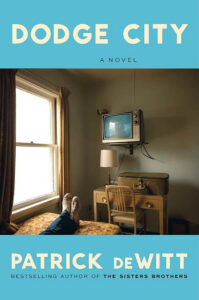
“It’s an unavoidable cliché in discussing Patrick deWitt’s fiction to note the surprising range of genres he takes on, from a realist addiction chronicle to an old-timey western to a screwball class satire and more. His output more closely resembles that of an old studio film director’s than of a typical contemporary literary novelist, with certain themes and preoccupations reappearing across books of otherwise disparate subject matter.
His dialogue in particular serves as a distinctive through line, with pages of repartee in an off-kilter, slightly formal register flowing through all of his novels. His writing tends toward the picaresque, his characters moving through series of strange encounters that accrue meaning through juxtaposition. I will not use the word ‘quirky,’ but its possibility often lurks just off the page.
…
Surprisingly, given the subject matter, this is not a story with a great deal of conflict, even though Lee finds each of his family members—father in Concrete, mother in Billings, Mont., brother in Duluth, Minn., and sister in New York City—in varying degrees of crisis. At times, it feels like a bookend to deWitt’s first novel, Ablutions, a breathtakingly ugly and inventive book about the doings of rock-bottom alcoholics in a Hollywood dive bar. As in that book, some of the best scenes in Dodge City depict baroquely self-destructive behavior, though here they’re presented in a gentler register.
…
“‘Do you think what you’re doing to America is friendly?’ Harry asks Lee at one point, to which Lee reasonably replies, ‘Going to Vietnam is friendly?’ I found myself thinking about why deWitt decided to write about 1967 now, why the story of a sensitive, not-terribly-political young man fleeing an unjust war felt urgent. It seems to me he’s saying, in a calm but firm voice, that sometimes doing the right thing isn’t actually complicated. Sometimes, when the call comes from a despotic government to commit violence against your conscience, the bravest thing you can do is refuse.”
–Andrew Martin on Patrick deWitt’s Dodge City (The New York Times Book Review)
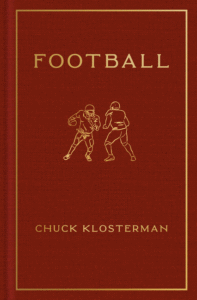
“Klosterman truly believes that the most popular and profitable sport in America is actually very fragile and will eventually collapse. This may come as a surprise to those of us in the present, but football’s demise, he explains, won’t happen for generations. Klosterman’s future reader, then, belongs to an imagined audience, the historians of a game that has long ceased to be.
…
“As one of his contemporary readers, someone who has watched his fair share of football and manages his fall schedule around NFL Sunday, I can only say that Klosterman’s vision of the end of football is hard to believe. Maybe that difficulty in imagining the sport’s death, like imagining the end of capitalism, comes from living in the present. In his introduction, Klosterman anticipates that struggle. But one wonders if he actually believes his own thesis, given that so much of the book is a defense of the sport. What is strange about Klosterman’s book, ultimately, isn’t his prediction of football’s death but the form his fandom takes: He spends most of the book writing from the position that football is a perfect game and then tries to disprove that conceit, despite professing an ardent belief in football’s virtues.
…
“Reading Klosterman’s thoughts on football felt broadly familiar, but his theory of football is clouded by abstractions and contradictions. And it’s not because he contends that the violence of the sport is not something that people enjoy, even though the NFL used to make compilations of the game’s biggest hits every week; it’s because he presents so many aspects of football as the idea of football, and not the reality that anyone who is a fan experiences every week. It’s a vision of the sport that dwells in Plato’s cave.
One of the clumsiest parts of Klosterman’s book is his attempts at political punditry. His first provocation is arguing that ‘all thirty-two NFL teams share their TV revenue equally, the most visibly successful example of American socialism.’ What he refers to as ‘socialism’ is the billionaire owners’ profiting from a closed system, and private companies that often force cities to pay for their stadiums and renovations while the owners keep the profits. And that’s without going into the power imbalance between the owners and the labor class of the NFL. Klosterman’s idea of socialism and its ethic of redistribution just doesn’t make sense, unless it’s simply the class solidarity of billionaires.
…
“What’s clear is that much of Klosterman’s book endorses tired myths about football: that it’s the greatest sport by virtue of its design and popularity, and that football’s popularity is a sign of its goodness. He often proposes counterarguments—the idea that the sport is structurally racist or that the NFL’s TV-viewing experience is subpar—but he dismisses these pretty quickly. Instead, he works backward from the conclusion that football is the greatest sport, and so these arguments are never meant to be engaged with seriously.
…
“Klosterman is right that football’s popularity in the United States means that the game is aligned with American culture and society in a way that other sports are not, though it’s not clear if he understands why that sentiment is true. Football isn’t war, but it profits off the country’s ability to wage war around the globe. If the players and coaches reach for military references all the time, it’s because of how intertwined the military is with the story of the sport. If we’re honest about that link, then we have to be honest about the fact that football’s popularity is tied to the thrill, or at least the pride, that people find in the violence of the country writ large—and how the sport has chosen to position itself, through design and narrative, as a secondary experience for that pleasure. If football and violence go hand in hand, then it’s harder to argue that it is good and superior by the nature of its design and that its popularity is a normal consequence of that superiority. The thing with obituaries, especially public ones, is that more often than not, they sanitize their subjects. People don’t like to speak ill of the dead. Klosterman’s book is no different: In this public performance of future mourning, he reduces the sport to its clichés.”
–Zito Madu on Chuck Klosterman’s Football (The Nation)
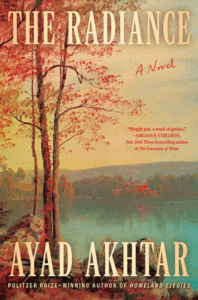
“Whether or not Roth’s books count as autofiction, for Akhtar the category is something of a red herring. Invoking it as insistently as he does in The Radiance is a way of scrambling signals rather than marking boundaries. The same is true of the other genre tropes he strews in the reader’s path. Is this a campus comedy? A novel of ideas? A medical mystery? A spiritual quest narrative? Yes, sure. All of it. And a lot more, packed into less than 300 pages. But also: Who cares? Taxonomy is taxidermy. Whatever this book is, it’s alive.”
…
“The campus novel parts of The Radiance, toggling between satire and melodrama, trembling at the crossroads of ambition, learning and lust, are at once queasily suspenseful and somewhat familiar. With the partial exception of Susan, Ayad’s class is stocked with the kind of overmedicated, trauma-curious, identity-obsessed youngsters who have figured in countless op-eds and magazine stories over the past couple of decades. The fluctuating power dynamic between them and their instructors, and the overall climate of hypersensitivity, ideological conformity and bureaucratic surveillance that hovers over the college, are by now commonplaces of fiction and creative nonfiction alike.
Ayad the narrator tries, in earnest and in vain, to stake out a demilitarized zone on the culture-war battlefield he has stumbled onto. Akhtar the author, though, is conducting a stealthy psyop aimed at detonating the certainties of combatants on both sides. He has done this before: Homeland Elegies and his Pulitzer-winning play, Disgraced, skewer Islamophobic intolerance and liberal multiculturalist piety with equal vigor. One of the most indelible characters in Homeland is Ayad’s Trump-loving immigrant father.
…
“Toward the end, Ayad will fret that his ‘identity as a writer is at stake. The experiences I was having were so central, so transformative—what did it mean that I couldn’t really find the words to convey their force?’ He shouldn’t worry. Akhtar has found them.”
–A.O. Scott on Ayad Akhtar’s The Radiance (The New York Times Book Review)
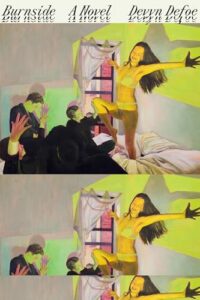
“In her hazy allegory about the odious delusions of liberal NIMBYism, Defoe drops her characters into a foul hyperreality, a place where a disillusioned Californian’s worst suspicions are often confirmed, and the bogeyman isn’t entirely folklore. The cumulative effect of the bowl’s ambient violence (robbery, assault, and overdose abound) amounts to an open-air despair not unlike Fox News-style depictions of California as a wholesale war zone. A fleet of ‘feral children’ from a derelict almond-growing town traipses around pilfering wallets. And arsonists, here, are many; they operate covertly as ‘unofficial fire officials’ who promote fringe theories of ignition online while setting fires ‘for gain, or for fun, or out of unexamined impulse, but they set fires either way.’ Reactionary beliefs and conspiratorial thinking are thus summoned out of these hipsters like a cobra from a basket.”
…
“The novel’s unrelenting misery is amusing at first, buoyed by the comically obvious foreshadowing of catastrophe that is endemic to noir, as well as Defoe’s knack for producing details in the Pynchonian wingding tradition (one character, Sid Julius, comes from an extended family whose every member is a ‘commercially licensed hot-air balloonist.’) But countless pages in this mode without critical friction prove tedious, as Defoe exhausts the few moves she has, bumping into the limits of irony and its auxiliary contrivances. She ultimately cannot resolve the regressive, madcap parochialism of her characters with the book’s noncommittal pleas for moral commitment. Amid so much belabored meanness, meager appeals to conscience scan more like self-conscious obligation, easily subsumed by impotence.”
…
“Ultimately, Defoe abandons any attempt to make material sense of the destructive social order within the bowl. What Burnside aspires toward instead is an expression of the place’s spiritual core, some evocation of a regionally specific truth that might explain the percolating rottenness. The daily realities that occur on the surface are merely collateral details in this quest. Insubstantial musings abound: ‘You can’t shake the feeling that something’s in the water. A force that drives people to madness, to destructive ends,’ September’s ex-boyfriend, the ‘thinking man,’ posits.
And Defoe, at various junctures, as if to solidify an aura of Californian violence, makes thinly veiled reference to the Death House Landlady, the Golden State Killer, and, of course, the Donner Party. Though these nods make for a delightfully perverse Sacramento ode—forget hometown heroes, bring on the hometown villains!—they do not cohere into a reckoning with the ecological disaster and antisociality that overwhelm the novel’s present. As Sacramento’s den mother (Didion, naturally) once wrote: ‘A good deal about California does not, on its own preferred terms, add up.’ I might say the same of Burnside. In that sense, Defoe has written a proper California novel.”
–Emma Hager on Devyn Defoe’s Burnside (The Baffler)
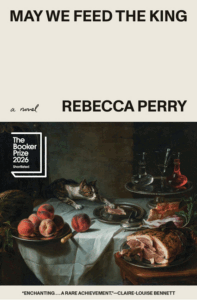
“In a medieval palace an unnamed king chafes under the new and unsought burden of power. His uncertain fate plays out in the present-day imagination of an unnamed curator of unspecified gender, who has been employed by the palace to dress some of its rooms for public viewing in the wake of an undescribed personal tragedy.
It’s likely that you’ll either be utterly intrigued or deeply put off by that summary of poet Rebecca Perry’s debut novel, May We Feed the King, a highly wrought puzzle-box of a book which deliberately wrongfoots the reader at every turn. However, the intrigued will find that it richly rewards those who approach it with curiosity—just not in the ways we as readers (and as interpreters of stories in any form) have been trained to expect.
…
“Perry’s poetry has been shortlisted for the TS Eliot prize. She has also published an essay in book form about trampolining—growing up, she competed nationally and internationally—and it doesn’t feel like a stretch to point out that in this book the views we are granted are often brief and strangely tilted, never quite stable. May We Feed the King is made up of glimpses of scenes from odd angles and perspectives, with confounding reflections, shadows and movements: rooms seen through windows or from doorways, conversations half heard. It is as though we, not the long-dead courtiers, are the ghosts, as we creep around the palace peering into its rooms dressed in careful set-pieces, trying to interpret complex and momentous events from the few clues left behind.
The King is given ultimate power—he can start wars, launch fleets, have subjects killed at a word—and yet its exercise requires total personal surrender: ‘the King sees an apple he would like to pick and someone is called to free it from the branch.’ His growing misery is that of someone raised as a subject who has objecthood forced upon him, and we sympathize with his quiet and then not-so-quiet rebellion as he seeks to escape his plight. More widely, the novel asks us to admit that we can know almost nothing about history, or even about the lives of people with whom we live contemporaneously. To read May We Feed the King is to be richly entertained but forced to sit with frustration: we want clues, we want certainty, we want a story about the King that makes sense, and Perry withholds it, instead making us watch our own minds scrabble about, compulsively putting together the scattered pieces of the past.”
–Melissa Harrison on Rebecca Perry’s May We Feed the King (The Guardian)