Kelima ulasan berkualitas minggu ini mencakup Joanna Scutts tentang Shawn Gude’s American Socialist, Dwight Garner tentang Barbara Trapido’s Brother of the More Famous Jack, Rhian Sasseen tentang Meghan O’Gieblyn’s Will and Attention, Lily Meyer tentang Madeline ffitch’s Avalon, Rise, dan Max Callimanopulos tentang Tom McCarthy’s The Rhyl Poster.
Dikumpulkan untuk Anda oleh Book Marks, rumah ulasan buku Lit Hub.
*

“What can the history of American socialism tell us about the present and future of democratic politics? The last decade has seen a resurgence of interest in socialism, from Bernie Sanders’s runs for president to the rise of Alexandria Ocasio-Cortez, and recently the election of Zohran Mamdani as New York mayor. Each of these figures has had to face the long-standing assumption in American politics that socialists just can’t find traction in the United States. American Socialist: The Life and Legacy of Eugene V. Debs, by former Jacobin editor Shawn Gude, offers an important corrective, illuminating the forces that shaped America’s foremost socialist evangelist, and the exceptional efforts of his opponents to crush him and his movement. Along the way, the book reveals a deeper truth: that in the United States, the story of socialism is really the story of opposition to socialism.
…
“As Gude describes it, Debs’s rhetoric fused nationalist and Christian mythology with Marxism, evoking the spirit of Christ and the fire of the abolitionists. It was a brew that appealed to crowds wherever he spoke. The era of political oratory made stars of the unlikeliest speakers, whose photographs or transcripts can barely convey what felt to audiences like an electrical current. Eugene Debs would spend the rest of his life spreading the gospel of this new political religion, and critics and followers alike would frequently compare him to Jesus Christ.
…
“The international socialists who inspired Debs at the start of his conversion were wildly excited at the prospects for American labor. How far might a nation go that had no kings to depose, no entrenched hierarchies to uproot, a country so young and iconoclastic and resource-rich? It was a disillusion as brutal as the mines and the mills, to see how powerful the pushback would be. The promise of American socialism is still unfulfilled, but this is a country in which almost anything can be resisted, rethought, and reinvented. Even politics. Even capitalism. Perhaps the story of Eugene Debs, told as meticulously as this, shows us that reinvention will not come from a single leader, no matter how inspiring, but from the collective resistance, and joyful community, of ordinary people.”
–Joanna Scutts on Shawn Gude’s American Socialist: The Life and Legacy of Eugene Debs (The New Republic)
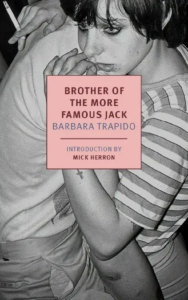
“…the shuckling on display is so good—so literate, funny, cruel and eccentric—that I slothed with this endearing novel immediately and was chagrined to have to climb out. This book is ideally short, yet one wants to live inside it, in the charmed parenthesis it opens inside the daily grind.
…
“Its awkward and hard-to-remember title—it’s an allusion to William Butler Yeats’s brother, Jack, a talented painter—may have kept the book from developing the audience it deserves. But it’s here again now. We should have been talking about Barbara Trapido all along.
Saya punya keterikatan khusus pada novel tentang orang muda yang tumbuh dalam lingkungan budaya sempit, dengan sedikit buku di rumah atau lukisan di dinding, yang merasakan ada cara hidup lain dan menemukannya dengan berteman, atau hampir diadopsi, oleh orang-orang yang tidak konvensional dan beradab. Ini adalah kisah saya sendiri, dalam semacam arti, dan itulah sebabnya One of Ours adalah novel Willa Cather favorit saya, bukannya My Ántonia. Brother of the More Famous Jack adalah ornamen bagi genre ini.
…
“Dialognya setingkat Stoppard. Jika tokoh-tokohnya adalah anjing, mereka akan selalu mengangkat kaki satu sama lain. Tetapi mengganggu, kebanyakan waktu, adalah cara mereka mengekspresikan kasih sayang.”
Brother of the More Famous Jack (I’m tired of even typing the title) strikes me as a pocket classic, a book that takes life seriously, earns its emotions and befriends the reader without getting all gooey about anything at all.”
–Dwight Garner on Barbara Trapido’s Brother of the More Famous Jack (The New York Times)
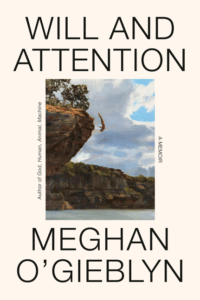
“Jiwa manusia: sebuah istilah kuno, berlapis patina dan kilau antik. Menganggap serius hal semacam ini di era nihilisme dan kekecewaan betrays a person as potentially unserious, someone committed to abstraction, to feeling over logic and material reality. And this is an era of binaries, in which the very instruments of our daily lives—the computers we type on, the phones on which we scroll—are reliant on a series of zeroes and ones.
But in the American writer Meghan O’Gieblyn’s latest book, the memoir Will and Attention, the soul, and the vast human consciousness and humanistic intellectual tradition for which this word functions as a shorthand, is not something so easily dismissed. Set mostly around the time of the pandemic, the book traces O’Gieblyn’s abrupt, frightening relapse into alcoholism, paired alongside her unexpected flirtation with Catholicism years after she renounced religion and became an atheist. In this sense, it is a book about obliteration in one form or another: the blotting out of the self that occurs when substance abuse obscures a person’s life from themselves, like an indistinct reflection in a mirror; the destruction of the individual when confronted with the divine.”
…
“O’Gieblyn, in the span of its pages, successfully manages to turn the authorial gaze fully on herself and the twinned problems introduced in its title: will, as in the idea of free will and to will to change our lives, and the attention we pay to self-examination and the world around us. Drawing on the French philosopher Simone Weil, the German philosopher Arthur Schopenhauer, Catholic theology, and more, O’Gieblyn produces an addiction memoir that transcends the form, and offers a salient exploration of what varieties of care and attention we owe ourselves and others.”
…
“This is an irony that O’Gieblyn is aware of in Will and Attention: that once some kind of equilibrium has been reached in a life, once some kind of happiness—a steady relationship, a thriving career, travel—has been achieved, boredom will set in. And from that boredom, a different kind of will, the willfulness that accompanies a need to destroy that happiness. Sometimes when I read books about alcoholism and addiction, I worry about my own reaction as the child of an alcoholic, a knee-jerk judgement toward the writer for the hurt they’ve undoubtedly caused their loved ones. This is unfair, I know; it’s not logical. Addiction itself isn’t logical; why this need to blot oneself out, to destroy oneself from within? The expansive quality of Will and Attention, the focus that it pays to this long history of human consideration toward this very question, allows it to sidestep the pitfalls of viewing addiction merely through the lens of disease or choice.”
–Rhian Sasseen on Meghan O’Gieblyn’s Will and Attention (The Baffler)
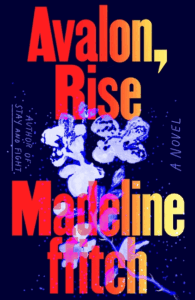
“Avalon, Rise is a sophisticated novel, intellectually complex and slyly funny at every turn. Like Abiyoyo, it is also a very direct story about facing evil with courage. Avalon, Rise makes the case on nearly every page that opposing the Big Bad is necessary. But that basic principle, the book suggests, does not make standing up to those who would destroy a community easy. Indeed, the ever-shifting balance between clarity and complication is central to the novel.”
ffitch is able to maintain this balance largely because she seems to have little interest in demonstrating purity—either her own or that of her characters. Avalon, Rise doesn’t care if its characters do the precisely correct thing. As a result, it achieves the rare feat of having a distinct sense of right and wrong, without ever becoming preachy or heavy-handed. It becomes an exploration of how confusing and hard it is to be good.
…
“By braiding these stories, and many more, into the tale of Avalon defeating its giant, ffitch tells a layered, sophisticated story that expresses a clear, ethical point of view without hammering readers on the head. Not many novels for adults do this successfully, but in children’s literature, it is one of the standards for a great book. ffitch includes many in Avalon, Rise: Abiyoyo but also Frog and Toad, Herschel and the Hanukkah Goblins, The Dead Bird. Each of these books demands that its characters face their situation with courage; each one takes something that seems simple—burying a bird, celebrating Hanukkah, all sorts of mundane tasks in Frog and Toad—and surrounds it with not just emotional complication but also mischief, humor, and delight.”
So, too, with Avalon, Rise, as it demonstrates that white supremacists are unwelcome in town. What Avalon, Rise understands as well as the classics of children’s literature is that when you’re a small, fallible, confused person, everything is exciting but almost nothing is easy. What it understands as well as any great adult novel is how hard it is to get people to work together, no matter how high the stakes. In bringing these two clear yet complicated pieces of knowledge together, ffitch has written a remarkable book.”
–Lily Meyer on Madeline ffitch’s Avalon, Rise (The Atlantic)
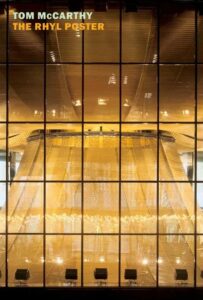
“Beberapa penulis cenderung tidak artikulatif saat mereka menua—di ujung kariernya, Beckett menukar frasa sunyi dan serpihan kecil yang tajam. McCarthy berjalan ke arah sebaliknya. Rasa geeky yang pertama kali muncul dalam The Making of Incarnation (2021)—dengan diagram Feynman dan kernel Fisher, terowongan Prandtl dan sistem infrastruktur hiper-konsolidasi—telah dengan tegas menegaskan dirinya atas prosa McCarthy. The Rhyl Poster penuh dengan referensi ke ‘jaringan dan penyebaran,’ ‘saluran asosiasi dan pengungkapan,’ jalan dan sudut, vektor, arus, dan ‘vektor kontra-fluial.’ Kita terombang-ambing di sini, pada dasarnya telah belajar bahwa sistem hukum Eropa besar dan rumit, dan bahwa McCarthy memiliki banyak kata untuk mengatakannya.”
…
“Squint and you might see the bones of a legal thriller—a John Grisham paperback written by Georges Perec. Look a little closer, however, and you’ll realize that The Rhyl Poster is nearly identical to McCarthy’s last two novels…Repetition and reënactment might be the twin engines of McCarthy’s fiction, but it’s slightly disheartening to read about these men and their fruitless attempts to construct ‘some kind of infrastructural master-meaning’ out of their times.”
“Saat aku menelusuri The Rhyl Poster, aku merasakan rasa terganggu bahwa McCarthy menggantungkan diri di bahu saya, tertawa atas anotasi kewajibanku dan komentar-komentar yang sering membuat frustrasi. Novel-novelnya memiliki cara untuk mencegah kritik (‘Events! Jika kau menginginkan yang seperti itu, sebaiknya berhenti membaca sekarang,’ tulisnya diawal Satin Island yang sebagian besar tidak banyak peristiwa), tetapi The Rhyl Poster melampaui dorongan biasa tersebut: tampak dirancang untuk mengalihkan setiap kenikmatan membaca yang saya kaitkan dengan karya. Kalimat-kalimatnya yang penuh jargon menggempur dengan kebanan yang rumit. Plotnya yang didaur ulang secara massal dari Satin Island terasa sibuk luar biasa dan sama sekali kosong. Jika pengalaman membaca Remainder seperti memasuki galeri yang sejuk dan tenang, maka membaca The Rhyl Poster mengingatkan saya pada tersandung ke toko barang bekas yang penuh dengan potongan-potongan yang telah dikumpulkan McCarthy sepanjang kariernya. Aku sampai di akhirnya dan meletakkan buku itu. Hanya kemudian, anehnya, itu mulai tumbuh dalam diriku.”
…
“…pada suatu saat seorang penulis yang begitu berkomitmen pada satu metode harus bertanya-tanya apa yang tersisa untuk dilakukan. Stanton, merenungkan penyelundupan dokumennya, memutuskan bahwa itu membentuk ‘drama topografis, bukan spiritual.’ Frasa itu mungkin dengan tepat menggambarkan seluruh karier McCarthy. Dia tidak pernah terlalu tertarik pada bagaimana atau apa yang dirasakan karakternya, tetapi di bab-bab terakhir The Rhyl Poster, ia tampak berusaha melarikan diri dari mereka sepenuhnya. Ia mungkin tidak pernah lagi menulis sebuah novel yang sebersih dan sekasar—atau jelas menyenangkan—seperti Remainder. Namun novelis yang pernah menemukan inspirasinya di ruang-ruang terkurasi dunia seni tampaknya, dalam momen-momen ini, menemukan jalannya menuju jenis buku lain: sebuah karya yang berhenti mencoba X-ray birokrasi dan institusi dan mulai, lebih sederhana, melihat dunia.”
–Max Callimanopulos on Tom McCarthy’s The Rhyl Poster (The New Yorker)