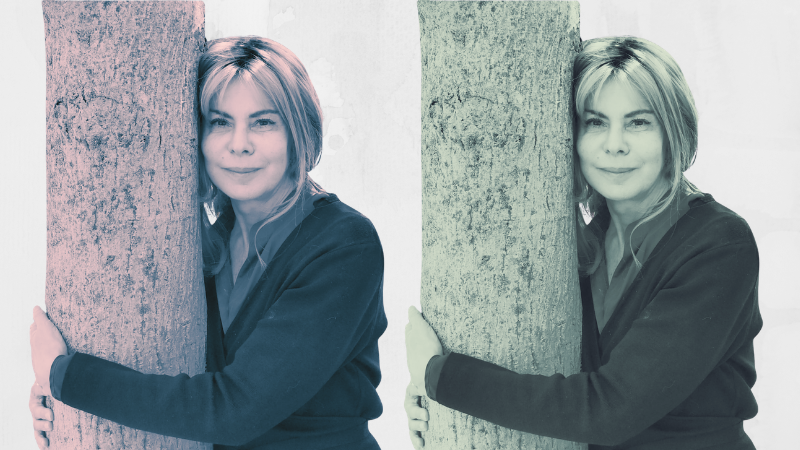
“In my poetry,” she said, “there has always been an emphasis on concrete detail, put more simply, I think I fell in love with reality….When we are interested in the world, we become disinterested in ourselves.” Antonella Anedda, born in Rome to a family with centuries of roots in Sardinia, shows us the consequences and artistic possibilities of her disarming and passionate relationship with reality in the bi-lingual volume of her selected works, Emerging from the Winter Sea, FSG, August, 2026.
Publikasi kompilasi kaya ini yang menelusuri delapan buku beliau, dari Winter Residences (1992) hingga Geographies (prose) (2021) datang pada saat puisi membutuhkan oksigen agar pembaca bisa bernapas lebih bebas setelah mereka menjumpainya. Menolak suara puitis imajinatif, karyanya menawarkan keindahan detail keseharian dari mana cerita membuat kebenaran tampak sebagai kompleksitas. Dari politik, lingkungan, hingga konsep diri, Anedda menarik dirinya kembali agar kita dapat merasakan sudut pandang simultan yang melepaskan bahasa dari narasi-narasi yang mempolarisasi.
“Jika saya menulis, itu dengan keprihatinan karena saya khawatir tentang kehidupan, orang-orang bahagia yang tertangkap dalam bayangan senja yang oleh senja itu tiba-tiba jatuh pada mereka dari belakang.”
Anedda’s capacity to turn perspectives around by narrating unwritten angles in the same story is her most characteristic gift. She often constructs a dialogue among the poem’s elements and the reader. Her juxtapositions nudge what is commonplace into something larger, polyphonic and new. Her poem “September 11, 2001″ is an example of how she opens reality. Alluding to the attack only in the title, Anedda notes a few events showing the effects, patterns and tasks of an illustrator, the men seeking martyrdom, as well as the earthworms, gnats and the snail working the soil. She herself kneels, leaving us somewhere quiet as we contemplate the other story.
*
“September—says the calendar half consumed with drawings
of insects on its pages. Almost October is anticipated by the shells of snails
one for every day to cancel fear with their slowness.
Praise these earthly creatures, the brief flight, the patient hand
that draws: against the flames, against the celestial sky of paradise.
Below in the vegetable garden the radiant architecture of earthworms,
a veil of ants under the apple tree. I kneel to the mud, the gnats
the snail, to the effort with which it climbs my fingers.”
Anedda’s way of capturing different moments from different linguistic or interpretive points of view allows the everyday elements of our lives to find space in poetry, democratically.
“The things I name in poetry are not noble:
they stay under the palate, waiting, conscious only of the warmth.”
In the same poem:
“It’s not music that you mean, but a thunderous clap of dishes, hail
that beats against the wall.”
Anedda resists explaining the dominance of largely male voices of past narrations. She sees oppression in many categories from poverty to war and as such creates space for other ways of telling. Anedda’s capacity to create a deeper frame of reference builds as she lets the world speak. She invites readers to hear other voices—nature, soldiers, daughters, slaves, the dead, weather reports, all constants, all changing.
“Autumn shines in a corner and the word forms
in its own rhythm: in clots, in vacuums,
in flashes, within centuries.”
Her language draws on ancient ones, dialects, extinct and modern ones.
“The word splits like wood
as wood crackling on one side
half burning
half abandonment.”
Anedda accepts her composite language for contemporary poetry, (although not without irony).
“I was thinking of larger words,
strong enough to shake every sound from the shrub
I heard it alive in the throat: a fervor
that would have recognized in things
a flash of wisdom.”
For English readers, whose cultures and histories have largely been defined by the individual, Anedda’s more collective interpretation of an identity repudiates social definitions. “What’s in a name? Nothing. A sound that summons a body, a bell that yokes you to it. To receive a name is the first proof that we are under the power of others.” She embraces fluidity and change. Writing poetry about violence is not the same as experiencing it.
“Turning our heads here, we think: while down there
it happens for real to the ones being chased.”
Thus, the way the environment, family, war, memory, art are written about arises from a natural concern about narrative. She suggests that much of the way we read is influenced by our beliefs. She challenges how much we can really know.
“We read history, we imagine the meaning of a siege.
Pots burn in the dark
full of wind and sand.
How else would you know to describe the vortex of hunger
that spins in the void with other ghosts?”
The traces of war appear in each of her books, as life and in death.
“News of the latest massacre arrives this evening
when you have put the last items in the washer
and pulled back the covers to ready the beds for sleep.
On the TV screen, the only light in the dark room,
dead faces and living dead, flashes of explosions,
naked bodies, and, in the rubble, a dog.”
“8:a.m.
we take the elevator down
unaware of storms on the coast
of corpses already tight in oilcloth and jute.”
For us not facing the bombs of actual war, the poet asks alarmingly direct questions about its persistent effects in all epochs.
—“You really think not to be punished is enough not to be guilty,
but you are guilty.
The air is full of screams. They stick to the walls.“
—“What makes the cemetery of a bombed city a cemetery.
Which contrast between the living and the dead, what memory of wind
and light—sea light—from the Pisan frescoes.”
She neutralizes narrations of glory.
…”the dust thrown to confuse
the verdict: we are not saved
we don’t save
except with an oblique courage
a gesture of minimum light.”
As her translator, Anedda’s thought, as well as some of her courage, became part of my existence in the long months such a project entails. Rendering something complex and alive, trying not to invent but remaining faithful to her language in another language, took over my thinking. Like a researcher in a lab, I was touching energies that were potentially life changing. I couldn’t allow them to escape. Translations can be done in many ways. Beside particular word choices and possible errors, the decision of how one interprets the work—whether to bring it into more contemporary form, to alter images to find equivalencies for English readers with different sensibilities—is a constant. Trying to come closer to her lexicon and her vision, instead of rendering a smoother poem in English, was my main challenge.
I have lived as a writer in Italy for nearly fifty years and I tilted when necessary, in that direction. For us who come from literary traditions with shorter histories, Anedda’s knowledge of language, her awareness of how it can die, how we forget its power to define and defend truths was the energy pushing my translations. Hers is a poetry that speaks from centuries of poetry, for its need for renewal, for its exits and entries into community, for its capacity to witness and invent, for the beauty of connection.
______________________________
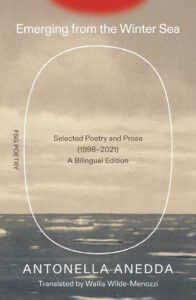
Emerging from the Winter Sea by Antonella Anedda, translated by Wallis Wilde-Menozzi, is available from Farrar, Straus and Giroux.