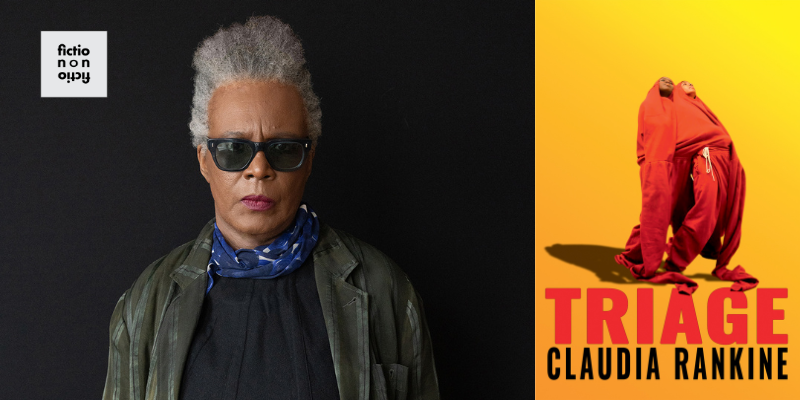
Poet, essayist, and playwright Claudia Rankine joins co-hosts Christian Barter, Jennifer Maritza McCauley and Whitney Terrell to talk about her new book Triage. Rankine outlines the decades-long relationship between the book’s narrator and a character she names “the theorist,” who, as college students, develop the habit of collapsing whenever they greet each other. She talks about how each character interprets collapse differently, the theorist prescribing action while the narrator fights for her “silences, routines, and quietude.” Rankine discusses how their “conversation” echoes Antigone and is rooted in our current reactions to the war in Gaza and the second Trump Administration. She reflects on the role that visual imagery has in her work and reads from Triage.
To hear the full episode, subscribe through iTunes, Google Play, Stitcher, Spotify, or your favorite podcast app (include the forward slashes when searching). You can also listen by streaming from the player below. Check out video versions of our interviews on the Fiction/Non/Fiction Instagram account, the Fiction/Non/Fiction YouTube Channel, and our show website: https://www.fnfpodcast.net/This podcast is produced by Christian Barter, Jennifer Maritza McCauley, and Whitney Terrell.
Claudia Rankine
Triage • Don’t Let Me Be Lonely: An American Lyric • Citizen: An American Lyric • Just Us: An American Conversation
Others
Antigone | Sophocles • Fiction/Non/Fction Season 8, Episode 51: Omar El Akkad on Gaza and Western Empire • Julia (1977) dir. Fred Zinnemann
EXCERPT FROM A CONVERSATION WITH CLAUDIA RANKINE
Whitney Terrell: Speaking of Antigone, there’s a scene later in the book where the narrator goes to the bathroom and reaches into her basket of books beside the toilet and reads some Antigone. The narrator is then driven to write a letter to the theorist, and that letter refers to various policies of the second Trump term.
She’s mimicking what they think, what the government is doing, right? No to trans people. No to choice. No to refugees. No to employment. No to FEMA. No to U.S. and USAID. No to free speech. And then in response to these policies, the narrator reaches back into Antigone, which she had just read, and says, “Shouldn’t our response at least echo what’s already been said? Be whatever you want, and I will bury you. It seems fair to me to die doing it.” Could you unpack that passage for us and talk about how it relates to this dialectic between the narrator and the theorist that you were just talking about?
Claudia Rankine: I teach at NYU, and I was so impressed by the students, their willingness to risk everything in service of their support for Gaza and for other things, as well. Then we look at a place like Minnesota and how people have shown up to the point of risking their lives and losing their lives. I really feel that in this moment, that is what is being asked of us. Are you willing to risk everything for anyone?
I felt like the rise up in that passage that I read had to do with the importance of demonstration at this point, the importance of showing up, which is ironic that the narrator is saying this because the narrator is the one that doesn’t actually do it, but expects it from the theorist. And to hear the theorist be in a state where the too-muchness of now suddenly has put them in a place where they want to just collapse without rising up disappoints the narrator to the point of anger.
Christian Barter: In the trilogy, which represents your prior three books, it seems like the reader is constantly aware of the power of language. I think about how in Don’t Let Me Be Lonely, there’s all these references to the language of drug companies and the language that’s on TV, the language that’s on the news after 9/11, politicians. A lot of it is wielded by dark forces: corporations, politicians, obsessively normative forces, but also by writers and artists and figures in Citizen, like Serena Williams, speaking back to the umpires. Or, in Just Us, the narrator drawing people out to have these difficult conversations about race.
And in Triage, the theorist argues that language is not enough. Do you see this book as an extension of the explorations that you are doing with language in those prior three books, or as in dialog with those books? Does this represent a reversal in or a questioning of what you’re doing there?
CR: I don’t think it’s a reversal because the process of Triage is the conversation. I think the American trilogy series was really about can people actually see the condition of the person in front of them? Can they speak to it? Can they talk to each other? Can they explain how they’re feeling and have a bit of empathy or a bit of history to inform their behavior?
Here, it’s almost like Triage is taking the advice of those books and performing the conversation. The book is actually organized into four conversations: the lecture, but then they have three meetings by the end of the book in which they state their positions and try and also reconnect in terms of their friendship. I really wanted the book not to be an instruction, but a performance.
The other thing that’s going on now is within families, within friendships, people have come to a stalemate. They refuse to talk to other people because they have different positions, and they see the unwillingness to engage as an action. They cannot perform an action that directly relates to the dead bodies, but they can refuse to engage those who don’t see how dire the situation is. So I wanted to say maybe let’s look at what it is to just keep going in these conversations.
WT: That’s what I was thinking about. As a novelist, I always remind myself I do not have to agree with my characters, and I also don’t have to resolve their differences. I just have to allow them to have the discussion, which is what it felt like you were doing in this book here. Did you yourself change in your thinking in the process of allowing these characters to have this discussion?
CR: Yes, I did. I had an alternative ending, actually, to the book, and I sent it to my publisher as a finished product, and they all loved it, and we were done. And then I wrote them and said, “You know, that’s not the right ending,” and they were like, “What are you talking about? It’s the perfect ending.” So I rewrote the ending and sent it to them, and at first they were like, “No, this is not right,” and I’m like, “Yes, it is right, actually. This is how it goes, in a way. It’s not as clean as the prior ending. It’s a different, more complicated, more human, more fallible ending, and that’s where we’re going to go with this.” Then they came around and said, “Yeah, okay, we see what you’re doing.”
WT: Can you tell us what the ending that you scrapped was, or that you changed?
CR: Well, in the original ending, it lined up more with Antigone, so the theorist died in that ending because in a way, it was about putting your life on the line to do something. I don’t know if you’ve ever seen this movie Julia with Jane Fonda, but in that movie Vanessa Redgrave is the Antigone character, and Jane Fonda is the Ismene character, and they have an ask as well. Vanessa Redgrave’s character ends up dying during World War II, and she’s fighting the Nazis. I rewatched that film, and I thought that’s too easy an out for this conversation, because that’s not exactly where we are. Where we are, people struggle to contend with a global dynamic that’s touching everyone as all these countries move to the right, as we are locking down, we are deporting, all of these things. There’s nowhere you can go where it’s not touching populations, whether it’s Morocco or South Africa or all the countries in Europe, and certainly climate change in Asia, and everything, everything is happening at full speed in the United States.
Jennifer Maritza McCauley: Speaking of your trilogy, we’re all huge fans of yours. I just want to pivot a little bit and spend some time talking about craft because you’re brilliant at craft. I want to talk a bit about crafting a series of brilliant shorter form pieces like those in Citizen and Don’t Let Me Be Lonely, that are kind of interconnected versus maintaining a sustained yet still emotionally complex narrative, as you do in Triage.
CR: I could not have written Triage as a 40-year-old, maybe not even as a 50-year-old. There’s something about being in the 60s where—there are multiple things. Having had cancer, I’m not feeling like I’m about to die, but once you have cancer, you think, “Everything I do better be the thing I’m doing, because you just never know,” and so it allowed me to do exactly what I wanted with Triage, on the level of craft.
I think all of those years working on a book like Citizen that was really interested in the tightening of language to the point where there was no extra; that it just communicated the interaction, and each word counted in a way that, in the longer form it doesn’t quite work in the same way. Just Us—that was also a kind of archival citational exploration that had as its impetus a kind of education around certain issues. Lonely was more lyrical, as well, and in all of them, the use of images.
Here in Triage, I thought, Look, Claudia, you’ve written nonfiction. You’ve written journalistic articles. You write poetry. Why not use what you know from each of these genres to craft this? So I thought, Okay, that will allow me to use the lyric as an internal stethoscope, so that the language of poetry could come in when I wanted to go in, and the reader would have to adjust to the adjustment of language in those moments. Then the more narrative would come out when it came out. The essayistic would be about talking about these art pieces, and all of it will have to live under the same umbrella. Let’s see if you can do it.
Transcribed by Otter.ai. Condensed and edited by Vianna O’Hara. Photograph of Claudia Rankine by Dirk Skiba.